


Change Management vs Project Management: How to Align People and Delivery
Two disciplines play critical roles in guiding organizations through change successfully: but when it comes to change management vs project management, which one should lead?
Both aim to drive outcomes that move the business forward. Yet they focus on different dimensions of success. Project management ensures initiatives are planned, built, and delivered efficiently. Change management ensures people understand, embrace, adopt, and sustain the associated changes that come with the initiative.
Misunderstanding the difference between change and project management leads to underprepared teams, delayed adoption, and unrealized ROI. The ability to distinguish and align both disciplines is now a core leadership competency.
For senior leaders, understanding how these two functions differ, where they overlap, and how they can work together determines whether transformation creates lasting business value or fades after launch.
Why They’re Often Confused
The confusion is understandable. Both disciplines exist to make change work. Both involve structured processes, stakeholder engagement, and measurable outcomes. The distinction lies in the type of work each manages:
Project management governs processes, systems or deliverables – the operational “what” and “how”. It involves more than scheduling but drives disciplined execution.
Change management addresses people’s behaviors, attitudes and mindsets – the emotional and cultural dimension of transformation. It’s not just about sending communications; it’s about changing behavior.
Project management delivers the system or solution; change management ensures that employees use it effectively and consistently. Recognizing this difference eliminates confusion, clarifies accountability, and allows organizations to plan for both execution and adoption rather than leaving one to chance.
What Is Project Management?
Definition
Project management applies specialized knowledge, skills, tools, and techniques to deliver something of value within defined parameters. It’s about turning vision into tangible outcomes – moving a team, product, or initiative from concept to completion with clarity and control. It provides structure to complex initiatives and ensures goals are achieved within time, cost, and quality constraints.
Core Elements
Project management typically follows five phases:
- Initiating – establishing objectives, scope, and justification
- Planning – defining timelines, budgets, resources, and governance
- Executing – coordinating teams and activities
- Monitoring and Controlling – tracking progress, resolving risks, adjusting plans
- Closing – finalizing delivery, measuring outcomes, and transferring ownership
Key tasks include defining project scope and deliverables, allocating resources, managing risks, tracking progress and communicating status.
Common tools include statements of work, project charters, Gantt charts, budget estimations, resource trackers
Example
A company rolling out a new Customer Relationship Management (CRM) platform relies on project management to select the vendor, configure software, migrate data, and coordinate rollout schedules. The focus is delivery – ensuring milestones are met and systems work as designed.
Benefits for Leaders
Effective project management turns strategic goals into executable action plans that leadership can monitor and steer. With enhanced focus and discipline, benefits include:
- Clear accountability and visibility into progress
- Improved efficiency and resource alignment
- Reduced risks and rework
- Consistent and predictable delivery on time and within budget
What Is Change Management?
Definition
Change management is the structured discipline that helps individuals and teams adapt to new ways of working. It focuses on readiness, adoption, and reinforcement – ensuring people embrace and sustain change rather than resist it.
Core Elements
Change management often progresses through four phases:
- Shaping – defining the case for change and desired outcomes
- Readiness – assessing impact, preparing stakeholders, and building engagement
- Delivering – executing communication, training, and support activities
- Embedding – reinforcing adoption and measuring behavioral sustainability
Common tools include frameworks such as Prosci’s ADKAR model, Kotter’s 8-Step process, and change readiness or impact assessments. Communication plans, training programs, and feedback loops translate strategy into practical employee experience.
Example
In the same CRM rollout, change management ensures employees know why the system matters, how it improves their work, and how to use it confidently. Communication campaigns build understanding; training builds competence; reinforcement builds long-term adoption.
Benefits for Leaders
Projects are 7 times more likely to meet goals with excellent change management, helping leaders translates a technical deployment into a cultural and behavioral shift that lasts. Structured change management turns change from a disruption into an opportunity for growth, leading to benefits such as:
- Reduced resistance
- Strengthened employee engagement and trust
- Organizational adaptability
- Increased long-term return on transformation investments
Core Competencies and Overlapping Skills
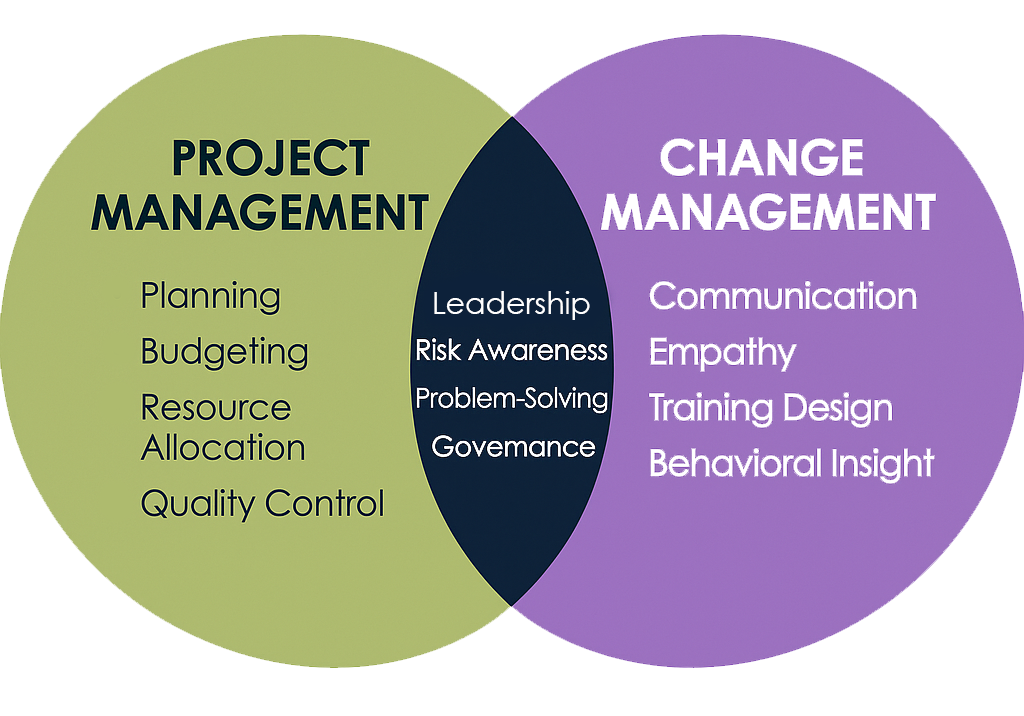
Leaders who build fluency across both skill sets are better positioned to sponsor complex change programs and sustain results beyond launch.
Frameworks and Methodologies
Both disciplines rely on established methodologies and frameworks to create predictability and accountability.
Project management frameworks:
- PRINCE2: process-based approach that emphasizes governance, documentation, and clearly defined roles
- Waterfall: follows a linear sequence of phases, providing structure and predictability for projects with stable requirements and a single timeline
- Agile/Scrum: promotes iteration, feedback, and adaptability for fast-moving projects
Change management frameworks:
- Prosci ADKAR: focuses on Awareness, Desire, Knowledge, Ability and Reinforcement – helping people move from awareness to sustained behavior.
- Kotter’s 8-step model: emphasizes urgency, leadership alignment, and cultural anchoring to drive lasting transformation.
- Lewin’s Model: guides people through Unfreezing, Changing, and Refreezing phrase – a foundational approach to managing human transition.
Many organizations blend both disciplines and operate within hybrid environments – combining Agile delivery with formal change management practices to handle continuous transformation.
Change Management vs Project Management
Although interdependent, the two disciplines serve distinct purposes.
| ASPECT | PROJECT MANAGEMENT | CHANGE MANAGEMENT |
|---|---|---|
| Focus | Deliverables, systems and processes | People, behavior and adoption |
| Structure | Linear and time-bound | Adaptive and iterative |
| Goal | Successful and technical delivery | Sustainable people adoption |
| Primary Constraint | Scope, budget and schedule | Human capacity and resistance |
| Measurement | Timeliness, cost, quality | Engagement, utilization and proficiency |
In practical terms, change management focuses on enabling people to embrace and sustain new ways of working, while project management ensures the technical solution is delivered effectively. Understanding how these disciplines complement each other helps leaders turn strategy into outcomes – aligning systems, processes, and behaviors behind a shared goal.
Which Approach to Prioritize
Project management leads when the focus is infrastructure, software, or process design.
Change management leads when transformation centers on culture, leadership, or values.
Both disciplines are critical for digital transformation, organizational design, or automation – initiatives where technology and people intersect.
Integrating Both Disciplines
When project management and change operate in sync, execution aligns with adoption and organizations deliver change that not only works but endures.
The Role of PMOs and CMOs
As transformation becomes a continuous enterprise capability and change efforts scale in size and complexity, many organizations formalize how they oversee both delivery and adoption. This often leads to dedicated functions that support project execution (PMOs) and guide people through change (CMOs). Project Management Offices (PMOs) ensure project governance, resource control and delivery discipline. Change Management Offices (CMOs) focus on culture, readiness, and adoption. PMOs and CMOs increasingly collaborate or merge to create unified governance. This structure connects project milestones with adoption checkpoints, ensuring leadership oversight across delivery and human impact. Some organizations even establish integrated “Transformation Offices” that unite these functions under shared leadership and metrics.
Integration Strategies
- Embed change management activities – communication, training, stakeholder engagement – into the project plan from initiation
- Create shared timelines, governance, and reporting mechanisms
- Establish shared KPIs across project and change functions, linking delivery milestones with adoption outcomes
- Position change and project leads as equal partners in planning and decision-making
Benefits of Integration
When both disciplines operate together, results extend beyond delivery. Adoption rates climb; time-to-value shortens; employee satisfaction rises; return on transformation investment improves. Integrating change management from the project start can increase ROI by 40-60% and lead to faster realization of benefits due to higher adoption. The message for leaders is clear: invest equally in system build and human readiness.
Example
In a digital transformation program, the project manager oversees system deployment and data migration; the change manager ensures leaders communicate vision, teams are trained, and feedback loops stay open. Together, they deliver both the system and the shift in behavior required to use it effectively.
Practical Tips for Integration
Shared Best Practices
- Define success criteria that measure both technical delivery and human adoption
- Maintain open, two-way communication between teams and stakeholders
- Engage affected employees early to understand real concerns and build trust
For Project Managers
- Define scope, deliverables, and dependencies transparently
- Schedule change milestones alongside technical ones
- Coordinate communication schedules and stakeholder updates
- Manage risks that emerge from behavioral or cultural barriers, not just technical dependencies.
For Change Managers
- Shape a clear narrative that links project outcomes to business goals
- Deliver training and reinforcement plans tailored to user roles
- Track adoption metrics (e.g pulse surveys, feedback channels) and escalate resistance patterns promptly
Challenges and Common Pitfalls
Even with shared intent, integrations can falter when priorities diverge. Common challenges include:
- Misaligned objectives or competing timelines
- Weak communication between project and change teams
- Leadership overemphasizing on technical completion rather than human adoption outcomes
- Undefined ownership for measuring post-launch success
How to Overcome These Issues
- Establish shared governance early, ideally through a transformation steering committee
- Include change management deliverables in the master project plan, not as an add-on
- Use joint status reviews that include technical and adoption metrics
- Recognize and celebrate behavioral milestones (such as adoption rates or proficiency gains) alongside delivery milestones
Organizations that monitor both delivery and adoption metrics maintain momentum beyond the initial rollout and sustain business impact.
The Evolving Relationship of Change Management vs Project Management
The boundary between project management vs change management continues to narrow as transformation becomes a continuous state rather than a finite event.
Key Trends:
- Digital transformation requires faster delivery and stronger adoption cycles; demanding permanent alignment between technical and people disciplines.
- Agile and hybrid delivery models rely on iterative work, requiring change managers to be embedded in sprints and backlog planning.
- Artificial intelligence enhances tracking, sentiment analysis, and predictive risk management, helping both disciplines act on data faster.
- Hybrid roles that bridge delivery and adoption – such as Transformation Leads or Change Delivery Managers – are emerging more, they combine the structure of project governance with the empathy and influence of change leadership.
Project Management Institute research shows that 75% of change initiatives fail when the people dimension is neglected. Organizations that invest in these dual competencies will manage transformation more fluidly, with less fatigue and stronger business outcomes.
Change Management vs Project Management – The Conclusion
The comparison between change management vs project management highlights two sides of the same coin – process and people working together to create lasting business value.
When both disciplines are integrated from the outset, organizations not only deliver projects on time and within budget but also achieve real adoption, improved performance, and cultural alignment.
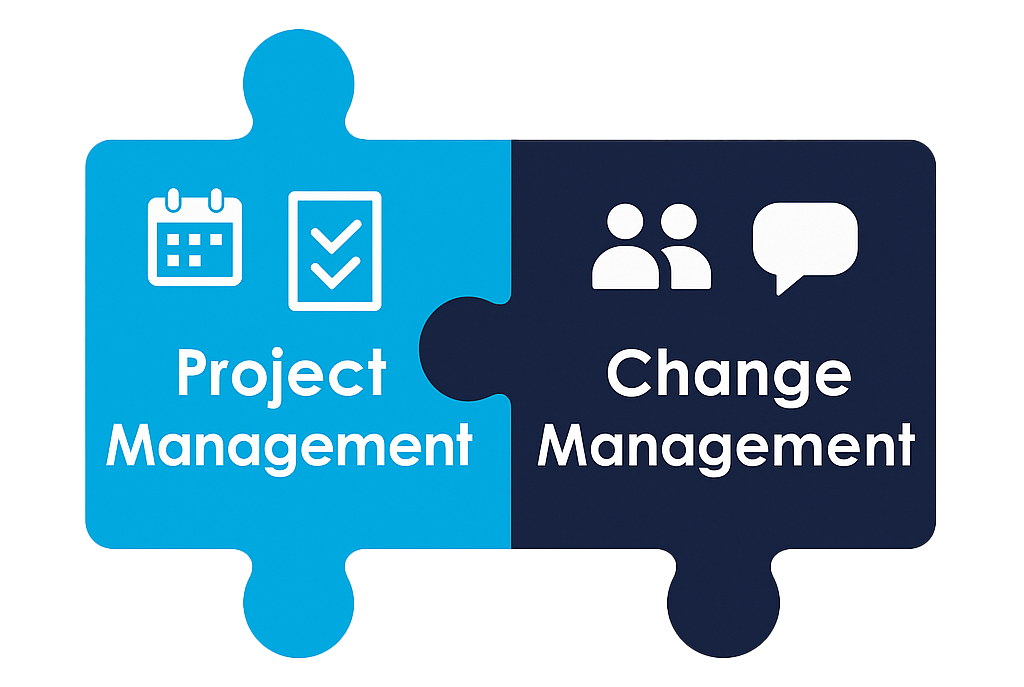
Understanding change management vs project management helps senior leaders build the right balance of structure and agility. Projects succeed when systems work and people use them confidently; sustainable change happens when both disciplines operate in concert.
Mastering this balance is now a strategic leadership skill. Those that manage change as well as they manage projects will continue to evolve, no matter how the landscape shifts.
For support aligning project delivery with lasting adoption – or building the right structures to manage both – get in touch with our team of transformation specialists.
Change Management vs Project Management FAQs
Project management typically starts first to define scope, timelines, and deliverables. However, change management should be integrated from the start – not added later – to prepare people for adoption. Successful transformations align both disciplines from initiation through implementation.
Yes. A project manager can transition into change management by developing people-focused skills such as communication, stakeholder engagement, and behavioral insight. Many leadership competencies—planning, governance, and risk management—overlap between both roles.
Stakeholder engagement ensures alignment, reduces resistance, and builds trust. In project management, it drives clear requirements and delivery support; in change management, it fosters buy-in and adoption. Active engagement improves both execution and human readiness for change.
It can be. Many organizations embed change management within the Project Management Office (PMO) or establish a dedicated Change Management Office (CMO). Increasingly, both functions collaborate, or merge, into unified “Transformation Offices” to link delivery with adoption outcomes.
Change management is often called organizational change, transformation management, or change leadership. All refer to guiding people through new ways of working to achieve sustained adoption and business results.
Effective change management directly improves project success by ensuring people understand, adopt, and sustain new systems or processes. Projects with strong change management achieve higher adoption rates, faster ROI, and reduced resistance after go-live.
Agile methods integrate easily by embedding change managers into sprints and backlog planning. Iterative feedback, communication, and training cycles align people adoption with rapid technical delivery, creating continuous improvement across both disciplines.
A change manager helps individuals and teams adapt to new processes, technologies, or strategies. They craft communication and training plans, assess readiness, manage resistance, and reinforce adoption to ensure lasting behavioral change.
Not exactly. A change manager focuses on people and adoption, while a project manager focuses on technical delivery and timelines. Both roles are complementary: when they work together, organizations achieve both successful implementation and sustained behavioral change.
