Free Five Minute Online Diagnostic
Change Readiness Assessment
Get a structured view of the conditions that can support or slow adoption
Change Readiness Assessment Tool
Are your people ready for change?
Get a structured view of the conditions that can support or slow adoption, instead of relying on assumptions.
A change readiness assessment evaluates whether an organization and its people have the conditions needed to adopt and sustain a planned change. Afiniti’s 6Lever™ Change Readiness Assessment is a five-minute self-assessment covering six dimensions of change readiness: Leadership, Drivers, Capability, Method, Engagement, and Culture. You’ll rate 18 statements and receive a personalized report showing your scores for each lever, along with practical next steps.
What your change readiness report includes
What your change readiness report includes
5 minutes | 6 levers | Tailored next steps
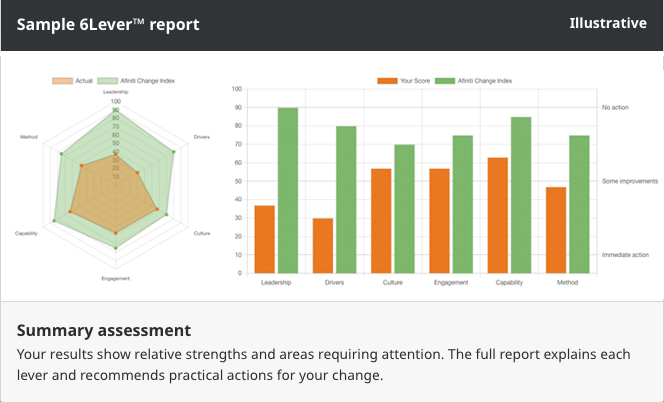
Your personalized report gives you a clear, visual snapshot of your current change environment.
- An overall readiness summary.
- A visual profile across all six levers.
- Your score for each lever.
- Comparison with the Afiniti Change Index.
- Commentary on potential strengths, gaps, and areas that may need attention.
- A unique results page you can return to using the link sent to your email.
Use the report to identify areas of strength, potential risks, and practical actions that could improve readiness.
Is a readiness assessment right for your organization?
A change readiness assessment is most useful while there is still time to influence the program, align leaders, and prepare employees before readiness issues begin affecting execution.
✔ You have an upcoming or active transformation that depends on people changing how they work.
✔ You’re introducing new technology, processes, roles, behaviors, or operating models.
✔ Realizing the expected value depends on effective adoption.
✔ You are unsure whether leaders, managers, or teams are sufficiently prepared.
✔ Multiple changes are competing for the same capacity and attention.
✔ Previous programs have encountered resistance, low adoption, or delayed benefits.
What is a change readiness assessment?
A change readiness assessment is a structured evaluation of whether an organization, program, or team has the conditions needed to understand, adopt, and sustain a planned change.
Readiness involves judgment as well as evidence. A structured assessment creates greater consistency by examining defined areas, gathering supporting information and giving stakeholders a shared language for discussing what they find.
It can be used at the org, team, or individual level to help identify:
- Conditions that are likely to support adoption.
- Risks, barriers and assumptions that need further validation.
- Groups that may require additional support.
- Where stronger leadership, engagement or resources are needed.
- Whether further prep would be useful before the next stage.

Signs of change readiness include:
- Employees understand why the change is happening.
- Leaders communicate a consistent story about the change.
- Managers can explain what the change means for their teams.
- People feel able to raise concerns and challenge assumptions.
- Feedback leads to visible action.
Common barriers to change readiness:
- Lack of clarity around the case for change or intended future state.
- Weak sponsorship and inconsistent leadership behavior.
- Change fatigue or insufficient capacity.
- Low psychological safety and concerns that remain unspoken.
- Unclear impacts or managers who have not been equipped to support their teams.
What does the Afiniti 6Lever™ change readiness assessment measure?
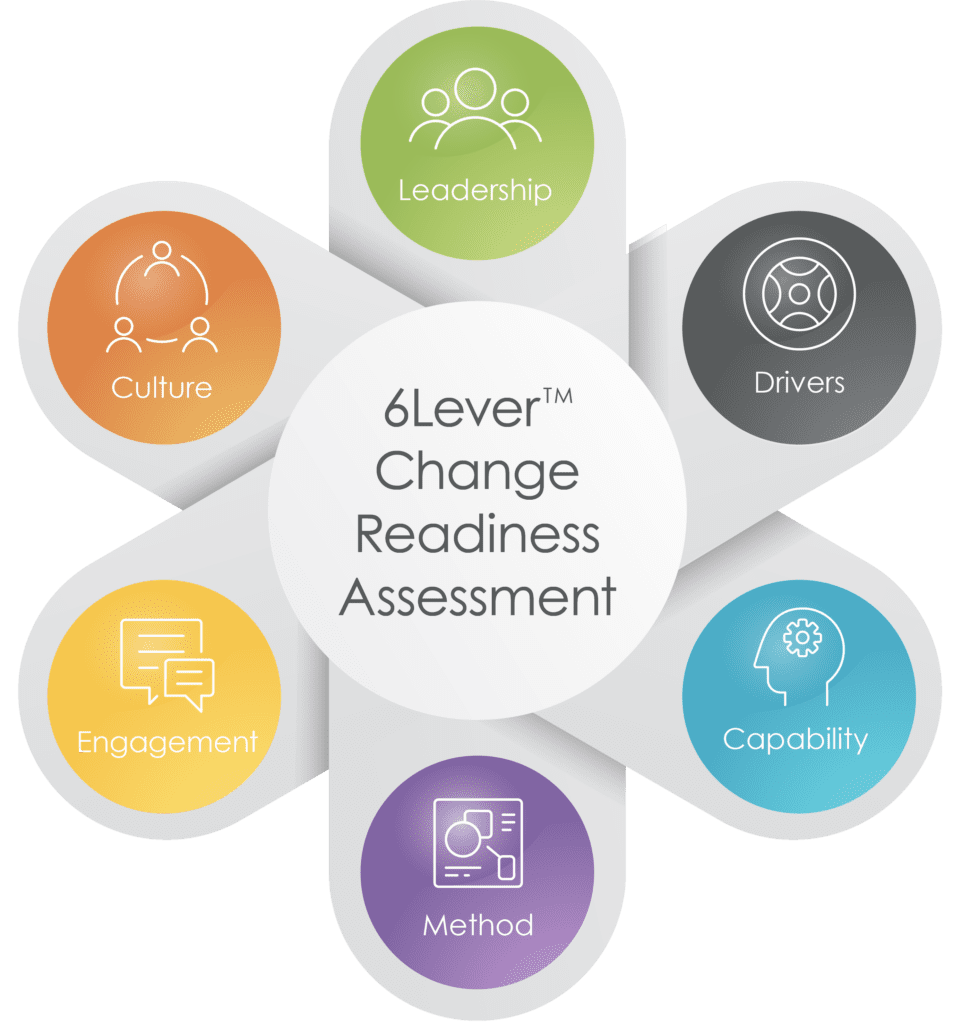
The Afiniti 6Lever™ Change Readiness Assessment model considers Leadership, Drivers, Capability, Method, Engagement, and Culture.
Afiniti’s 6Lever™ model was developed from more than two decades of change, transformation, and business experience. It examines six connected conditions that influence an organization’s ability to implement and sustain change.
Select a lever to see what it measures, sample assessment questions, and practical Afiniti insights.
Leadership
How well leaders are aligned, equipped, and committed to actively sponsor and lead the organization through change.
What to look for
- Leaders communicate a clear, consistent case for change and the outcomes the organization is working toward.
- Executive sponsors remain visible, active, and clear about their responsibilities throughout the change.
- Leaders address resistance, model the behaviors they expect from others, and communicate openly about challenges, progress, and lessons learned.
Example change readiness questions
- Do leaders communicate success stories, challenges, and lessons learned in an authentic way?
- Do leaders actively help identify and address resistance to change within their areas?
Afiniti insight
“All change begins with leaders. They set the direction, the tone and role model behaviours, ‘walking the walk and talking the talk’.”
Read more: Becoming an Effective and Visible Change Leader
Leadership in practice: See how Afiniti united 53 global HR leaders
Drivers
How clearly the organization defines the business need for change, the outcomes it expects to achieve, and the path from the current state to the future state.
What to look for
- A clear business case connects the change to strategy, expected benefits, and the intended future state.
- Employees understand what is changing, why it matters, and how their work contributes to the broader outcome.
- The direction stays clear as the program evolves, including what needs to happen, when it needs to happen, how it will be delivered, and who is accountable.
Example change readiness questions
- Is the change strategy, including the what, when, how, and who, clearly defined and understood across the organization?
- Does the organization understand the root causes of resistance and take action to address them and build employee trust?
Afiniti insight
“The business case can be seen as a tick-box exercise that gets forgotten about once signed off.”
Read more: Building a Compelling Business Case: The Foundation of Successful Change
Drivers in practice: See how Afiniti turned a North Star into an actionable roadmap
Culture
Whether the organization’s culture encourages openness, adaptability, collaboration, and constructive responses to the challenges that come with change.
What to look for
- Openness, adaptability, and constructive challenge are reinforced through everyday behaviors and decisions.
- Employees feel safe raising concerns, discussing difficulties, and challenging assumptions without those views being dismissed or suppressed.
- Values, recognition, and leadership behavior reinforce the change in day-to-day work, rather than supporting it only in principle.
Example change readiness questions
- Is openness to change recognized and rewarded, both formally and informally, across the organization?
- Does the working environment allow people at every level to speak candidly about issues, concerns, and what is happening in practice?
Afiniti insight
“Culture can reinforce desired, shared behaviours, which often get overlooked in favour of tools and processes.”
Read more: Benefits of Stakeholder Engagement and Strong Culture: 6Lever™ Change Readiness Assessment Insights
Culture in practice: See how a new operating model helped shift culture and employee mindsets
Engagement
Whether the people affected by the change are informed, involved, equipped, connected, and committed to moving it forward.
What to look for
- Employees have meaningful opportunities to ask questions, contribute ideas, provide feedback, and influence how the change is implemented.
- Communication works in both directions and uses channels appropriate for different audiences, locations, and stakeholder groups.
- Formal feedback and day-to-day employee sentiment show that people feel connected to the change, rather than simply receiving information about it.
Example change readiness questions
- Do informal conversations among employees suggest a positive and constructive view of the change?
- Are communication channels varied, accessible, and measured for effectiveness?
Afiniti insight
“Engagement must be multi-dimensional: Storytelling, role modelling and listening each play a distinct role and are most powerful when combined.”
Read more: Supporting Workforce Engagement in an Era of AI Transformation
Engagement in practice: See how co-creation accelerated stakeholder alignment
Capability
Whether the organization has the people, skills, capacity, and resources needed to deliver the change and operate effectively in the future state.
What to look for
- The skills, competencies, capacity, and resources required for the future state have been clearly identified.
- Employees affected by the change have the support, learning, and development they need to build new capabilities.
- The organization has enough internal change capability to support implementation and sustain adoption beyond individual projects or external consulting support.
Example change readiness questions
- Has the organization identified the capabilities and skills needed to sustain the change, such as digital, data, and business process skills?
- Is sufficient change management capability available through centralized resources, business functions, or established roles within project and program teams?
Afiniti insight
“We don’t change the organisation; we help the organisation’s people to drive the change.”
Read more: Building Change Capability: Teaching Your Organization to Fish
Capability in practice: See how Afiniti built sustainable internal change capability
Method
Whether the organization has clear, practical, and consistently applied ways to plan, govern, deliver, and adapt change.
What to look for
- A clear, proportionate approach is in place for shaping, governing, and delivering the change.
- Benefits, impacts, risks, and actions have clear ownership and are reviewed throughout implementation.
- Teams use experience and evidence to adjust their approach when something is not delivering the intended result.
Example change readiness questions
- Are benefits and impacts identified, documented, regularly measured, analyzed, and assigned clear ownership as part of change delivery?
- Are lessons learned captured and used to improve future change programs?
Afiniti insight
“Start with your context, not the model. Diagnose before you prescribe.”
Read more: Change Models: How to Select, Blend and Apply Them Effectively
Method in practice: See how a global digitalization program created greater consistency
Afiniti’s 6Lever™ model was developed from over two decades of change, transformation and business experience to examine six interdependent conditions that influence whether an organisation is prepared to implement and sustain change.
CHANGE READINESS CASE STUDY
1,000
impacted people
10+
global exec leaders aligned
70%
engagement rate
Building change readiness during major transformation
A global energy consultancy with more than 1,000 people was navigating significant transformation. Organizational changes, commercial pressure and leadership turnover had created fragmentation, change fatigue and uncertainty.
Afiniti’s contribution
- Conducted 12 in-depth leadership interviews and facilitated discussions with senior leaders.
- Structured the findings around the six change levers.
- Turned the findings into a practical business change plan with clear leadership responsibilities.
- Adjusted the approach to support an unexpected CEO transition.
The engagement identified risks that had previously been based largely on assumption, helped maintain momentum through the leadership transition and informed the incoming CEO’s roadmap.
“The Afiniti team are very easy to engage with, and they give confidence in their expertise as business change specialists.” CEO
When should you assess readiness?
When should you assess readiness?
Before launch, during execution or when you need to course-correct.
Readiness changes as programs progress. Assessing it at the right points can show where leadership, capability, engagement or organizational capacity needs attention before those issues begin affecting adoption.
- While shaping the strategy and business case for change.
- Before program mobilization or a major design decision.
- Ahead of rollout or go-live.
- When adoption, trust or engagement is declining.
- After a major change in leadership, scope or direction.
- At the beginning of a new release, wave or phase.
- When multiple programs are competing for capacity.
- After corrective action, to review progress.
Use the assessment as a planning and decision-making tool throughout the change lifecycle.


How to run a change readiness assessment
A useful assessment starts with a clearly defined change, the right stakeholder perspectives and a willingness to investigate what sits behind the scores.
the change being assessed
Clarify the type of change, strategic purpose, intended outcomes, affected business areas, number and types of people impacted, scale, program stage, and the decision the assessment is intended to support.
Consider impacts across processes, systems, tools, roles, skills, behaviors, the operating model, governance, KPIs, data, and employee, customer or supplier interactions.
the right perspectives
Gather input from leaders and sponsors, managers, impacted employees, change practitioners, HR, and program teams. External facilitation can be especially helpful when neutrality, constructive challenge, or participation across multiple functions is important.
Define the change clearly enough that respondents are evaluating the same initiative rather than their general feelings.
multiple types of evidence
Interpret readiness scores alongside change impact assessments, interviews, surveys, focus groups, training needs assessments, engagement data, adoption measures, and lessons from comparable changes.
Look for patterns, differences between stakeholder groups, and communities that may be particularly exposed. An overall average rarely tells the whole story.
findings and reassess
Use the findings to identify actions related to leadership, communication, engagement, managers, learning, capacity, governance, and risk. Give each material action an owner, target date, measure and review point.
Repeat the assessment at an appropriate program phase, rollout wave, or decision point to see whether conditions are improving or if new risks have emerged.
How to understand your result
Read the profile, not just the overall score
Your result is directional rather than a pass-or-fail judgement.
- Leadership: sponsorship and visibility.
- Drivers: purpose, benefits and future vision.
- Capability: time, resources, skills, and support.
- Method: governance, decisions, risks, and delivery.
- Engagement: involvement, feedback, and local ownership.
- Culture: trust, fatigue, and established behaviours.
Pay attention to the pattern across all six levers. Differences between them can help identify where attention may be most valuable. For complex or enterprise-wide change, comparing perspectives from multiple stakeholder groups can provide a broader view of readiness.

How the Afiniti Change Index is used
Your results are compared with the Afiniti Change Index, a change readiness reference developed through more than 20 years of Afiniti’s experience supporting organizational change.
The Index weights the six levers differently, reflecting our practitioners’ experience that some conditions require greater emphasis when preparing an organization for change.
Comparing your results with the Index can help identify:
- Areas of relative strength.
- Levers that may require more attention.
- Priorities for further investigation and discussion.
- Areas where targeted action could strengthen readiness.
Your change may be ready in some areas and exposed in others
Our online assessment data shows why a single overall readiness score can hide important differences. Across 159 analyzed assessments, 66% had at least a five-point gap between their strongest and weakest readiness lever. In one in five, that difference was ten points or more.
The practical implication is simple: focus on where readiness is strong and where the change could run into problems. A lower-scoring lever may point to an area that needs additional investigation, discussion or action before it begins affecting delivery.
No single lever consistently scored lowest across the assessments. Average scores for all six were relatively similar. There is no universal readiness problem or universal solution. The pattern within your own results is more useful than comparing yourself with a supposed “typical” weakness.
Based on 159 cleaned submissions to Afiniti’s online Change Readiness Assessment.
Free change readiness assessment template
Free change readiness assessment template
Use this change readiness assessment template to plan your assessment, capture evidence and stakeholder perspectives, prioritize readiness issues, and assign clear actions.
The workbook is designed to complement Afiniti’s 6Lever™ online assessment. Use 6Lever™ for your scored readiness diagnostic and comparison with the Afiniti Change Index, then use the template to explore what sits behind your results and:
- Structure stakeholder input.
- Capture evidence across the six levers.
- Turn findings into owned actions and future reassessment.
This is an editable Excel workbook. It does not introduce a separate scoring model; it helps you investigate and act on your 6Lever™ results.

Common readiness mistakes
- Treating readiness as a checklist
- Assuming leadership alignment
- Failing to equip managers
- Mistaking training attendance for readiness
- Inviting feedback without acting on it
- Relying on previous success
Completing an assessment does not make an organization ready. The value comes from understanding the findings and taking action.
Why Afiniti?
Afiniti has more than 20 years of experience helping organizations shape, deliver, and sustain complex business change. That experience informs 6Lever™, our structured approach to assessing Leadership, Drivers, Capability, Method, Engagement, and Culture.
We look across people, processes, systems, and data to identify areas where change may need greater attention. For complex transformations, our practitioners can take the assessment further by gathering input from representative stakeholders and facilitating discussions that explore what sits behind the scores and turn the findings into practical priorities.


Meet our change readiness practitioners
Change readiness assessment FAQs
A change readiness assessment is a structured way to understand how prepared an organization, team, program, or project is for change. It helps identify existing strengths, potential barriers, and areas that may need additional attention before or during implementation. Afiniti’s 6Lever™ assessment evaluates readiness across six areas: Leadership, Drivers, Capability, Method, Engagement, and Culture.
Afiniti’s 6Lever™ assessment examines six conditions that influence readiness for change: Leadership, Drivers, Capability, Method, Engagement, and Culture. Together, they consider areas such as leadership commitment, clarity of purpose, available skills and resources, the approach used to manage change, employee engagement, and whether the organization’s culture supports successful adoption.
The online assessment is most useful for someone with a strong understanding of the change and the environment in which it is taking place. This could include an executive sponsor, program or project leader, change practitioner, or senior stakeholder.
For a broader view of organizational readiness, Afiniti can gather input from leaders and representatives across different functions, teams, or stakeholder groups. Facilitated discussion can then help uncover why perspectives differ and where additional attention may be needed.
Assessing readiness early gives you more time to address gaps before they begin affecting implementation or adoption. Readiness can be considered while shaping the initial change strategy, before major implementation stages, during rollout, or whenever circumstances shift.
For longer or more complex programs, repeating the assessment at key milestones can help identify changes in readiness, emerging risks, and priorities that may need to be adjusted.
A change readiness assessment evaluates how prepared an organization and its people are to adopt and sustain a change. A change impact assessment identifies what the change will affect, including roles, processes, systems, skills, and ways of working.
Used together, they provide two complementary perspectives: what is changing and how ready the organization is to respond to those changes.
The online 6Lever™ assessment takes about five minutes to complete. You’ll receive a personalized report showing your results across all six levers, areas that may need additional attention, and practical recommended actions.
Your results are also compared with the Afiniti Change Index, helping you understand the relative pattern of readiness across Leadership, Drivers, Capability, Method, Engagement, and Culture.
If you want to explore the findings in more detail, one of Afiniti’s change consultants can discuss your results with you and help identify areas for further investigation or action.
-
Find out where your change needs attention
Get a practical view across all six readiness levers
Complete the five-minute assessment to identify relative strengths, potential gaps, and practical next steps.
-
Related Posts
- About Your Change (current step)
- Readiness Questions 1
- Readiness Questions 2
- Readiness Questions 3
- Get Your Report
- About Your Change (completed)
- Readiness Questions 1 (current step)
- Readiness Questions 2
- Readiness Questions 3
- Get Your Report
Please consider below statements. Score each appropriately depending on how much you agree or disagree, where a score of 10 would mean you totally agree, a score of 1 would mean you totally disagree.
Please complete each question. Try not to reflect too long on the statements; typically your first reaction is the correct score.
Disagree
Agree
- About Your Change (completed)
- Readiness Questions 1 (completed)
- Readiness Questions 2 (current step)
- Readiness Questions 3
- Get Your Report
Please consider below statements. Score each appropriately depending on how much you agree or disagree, where a score of 10 would mean you totally agree, a score of 1 would mean you totally disagree.
Please complete each question. Try not to reflect too long on the statements; typically your first reaction is the correct score.
Disagree
Agree
- About Your Change (completed)
- Readiness Questions 1 (completed)
- Readiness Questions 2 (completed)
- Readiness Questions 3 (current step)
- Get Your Report
Please consider below statements. Score each appropriately depending on how much you agree or disagree, where a score of 10 would mean you totally agree, a score of 1 would mean you totally disagree.
Please complete each question. Try not to reflect too long on the statements; typically your first reaction is the correct score.
Disagree
Agree
- About Your Change (completed)
- Readiness Questions 1 (completed)
- Readiness Questions 2 (completed)
- Readiness Questions 3 (completed)
- Get Your Report (current step)
Get your personalized 6Lever™ report
Enter your details to view your results and receive a link to your personalized report by email.
