


Change Leadership: An Executive Guide to Driving Transformation
Leading through change is one of the most demanding responsibilities placed on senior executives. Organizations that lack the ability to evolve struggle to outperform competitors, and even market leaders can quickly lose relevance. Competitive pressures shift, technology cycles shorten, regulatory landscapes change and customer expectations advance faster than most operating models were built to accommodate. Across organizations that manage this complexity well, one factor consistently differentiates success from stagnation: change leadership.
Change leaders function as the primary sponsors of transformation. They initiate change, establish its importance and remain accountable for ensuring it is delivered and embedded into day-to-day operations. This responsibility spans board members and C-suite executives leading enterprise-wide initiatives such as mergers and acquisitions, digital transformation or operating model redesign, as well as senior leaders sponsoring smaller, lower-risk programs within functions or business units. In every case, leaders supply the authority, prioritization and organizational credibility that enable change to move forward.
Effective change leadership requires leaders to work together toward a shared understanding of strategic objectives and the changes required to achieve them. Alignment at the top is essential. Yet execution remains a persistent challenge. A significant proportion of change programs fail to achieve their intended outcomes, and ineffective change leadership is frequently the underlying cause. Our 6Lever™ change readiness assessment consistently highlights this issue. Leadership carries the highest benchmark expectations of any lever, reflecting its importance, while also ranking among the lowest in actual performance across organizations.
This disconnect between what organizations expect from leaders and what they experience in practice raises a critical issue. What does change leadership really involve, and why do so many capable executives struggle to deliver it effectively?
The difference between change management and change leadership
Change leadership and change management are often used interchangeably, but they represent distinct and complementary disciplines. Both are necessary for successful transformation, yet they operate at different levels and serve different purposes.
Change management
Change management focuses on execution and adoption. It addresses how people transition to and use new ways of working through structured processes and disciplined planning. Change specialists, project managers and operational leaders collaborate to assess impacts, engage stakeholders, develop implementation plans and monitor progress against defined metrics. Change management provides the tactical navigation required to guide an organization through the mechanics of change.
In practical terms, change management answers the question of how change will be implemented. It ensures that activities are coordinated, risks are mitigated and employees receive the information and support needed to adopt new processes, systems or behaviors.
Change leadership
Change leadership operates at a strategic level. It is concerned with direction, belief and cultural shift. Change leaders define where the organization is going, why that direction matters and what success looks like. They shape the narrative, set priorities and model the behaviors required to realize the vision. This demands active and visible sponsorship from senior leaders who demonstrate commitment through their actions, not just their words.
Change leadership answers a different set of questions. Why is this change necessary? What future state are we working toward? How does this transformation align with our strategy and values?
Organizations require both disciplines. Without strong change leadership, even the most sophisticated change management efforts risk becoming exercises in executing the wrong initiatives efficiently. Without effective change management, ambitious visions struggle to translate into sustained operational reality.
Roles That Enable Effective Change Leadership
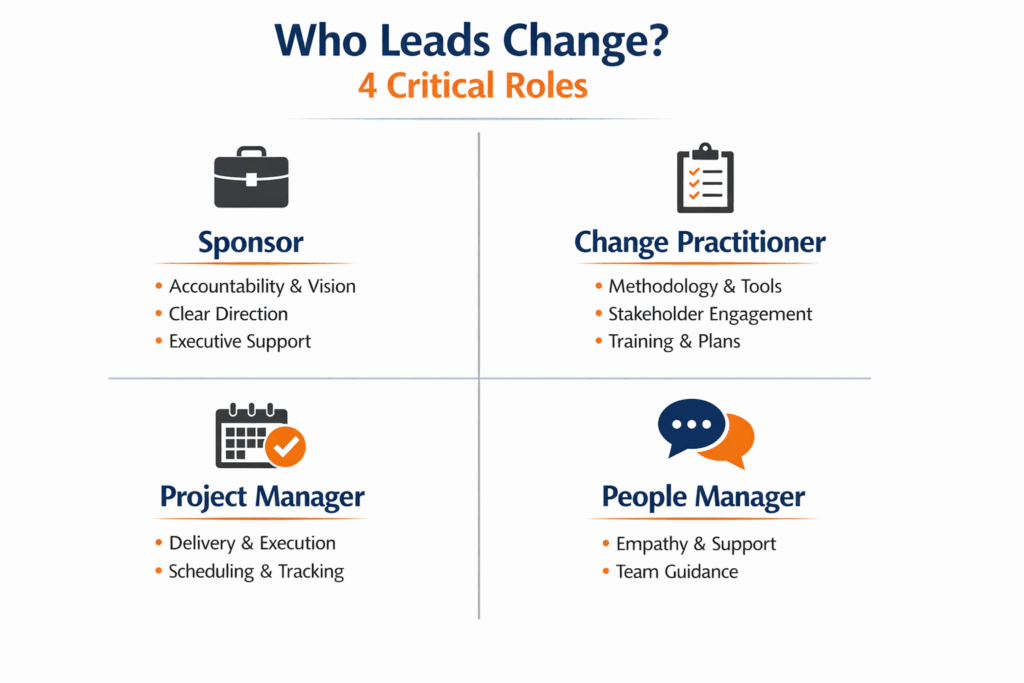
Change leadership is not confined to a single role or title. Multiple leadership positions contribute to successful transformation, particularly in large or change-mature organizations. While these roles may overlap in smaller environments, clarity around responsibilities helps strengthen accountability and execution.
Executive sponsors
Sponsors are senior executives who authorize, initiate and remain accountable for change initiatives. Effective sponsors maintain an active, visible presence throughout the lifecycle of the change rather than approving a business case and disengaging. They articulate direction, reinforce priorities and remove obstacles that slow progress.
Most large-scale transformations require a primary sponsor, typically a C-suite executive with enterprise accountability, supported by a coalition of peer sponsors. These sponsor coalitions play a critical role in cascading change across functions, regions and business units, translating enterprise strategy into locally relevant action and reinforcing consistent messages across the organization.
Change practitioners
Change practitioners are specialists who design and coordinate change strategies and execution plans. They bring methodological discipline, often grounded in approaches such as ADKAR, Kotter or Prosci. Their responsibilities include assessing organizational readiness, designing communication and engagement strategies, coaching leaders on change leadership behaviors and measuring adoption over time.
Change practitioners act as the connective tissue between strategic intent and employee experience. They help ensure that leadership vision is translated into coordinated action and that human factors receive the same level of attention as technical delivery.
Project managers
Project managers focus on the technical delivery of change. They manage timelines, budgets, scope and resource allocation for initiatives such as system implementations, process redesign or infrastructure upgrades. While their primary focus is on delivering solutions as planned, close collaboration with change leaders and practitioners is essential to ensure that technical outcomes align with business objectives and adoption realities.
Project managers build the solution. Change leadership ensures that the organization is ready and willing to use it.
People managers
People managers guide employees through the day-to-day impact of change. They translate strategic messages into practical implications, explain what is changing and why, address concerns and provide emotional support during transition. They also play a critical feedback role, surfacing issues and insights from the frontline to senior leaders.
Employees consistently report that their direct manager is the most trusted source of information during change. This positions people managers as essential change leaders, regardless of whether they hold formal roles in transformation governance structures.
The Risks of Inadequate Change Leadership
Weak change leadership creates cascading risks that extend well beyond missed milestones or delayed deliverables. When leadership commitment is inconsistent or unclear, change initiatives quickly lose priority as operational demands take precedence. Without visible champions at senior levels, attention and resources are diverted elsewhere.
This leadership gap breeds uncertainty and resistance to change. Employees question the legitimacy of the change when leaders fail to communicate consistently or role-model new behaviors. Ambiguity around expectations, benefits or decision-making authority increases anxiety, reducing productivity and elevating attrition risk among high performers who are unwilling to operate in prolonged uncertainty.
Resistance intensifies when employees perceive leadership inconsistency. When senior leaders appear exempt from the very changes they mandate for others, credibility erodes rapidly. This loss of trust makes future engagement significantly more difficult and slows adoption across the organization.
The financial and operational consequences are substantial. Poor change leadership contributes to delays, cost overruns and reduced return on investment. In more severe cases, organizations invest heavily in transformation initiatives that fail to embed, reverting to legacy processes within months of formal completion. The cost is not only financial but reputational, weakening confidence in leadership and reducing appetite for future change.
Foundations of Effective Change Leadership
Defining and sustaining purpose
Effective change leadership begins with clarity of purpose. Successful change leaders articulate why the change is necessary, how it aligns with organizational strategy and what benefits it will deliver. This clarity creates commitment rather than compliance and helps employees understand how their efforts contribute to broader objectives.
Purpose should be established early, ideally during business case development, and reinforced throughout the transformation lifecycle. The change rationale acts as a North Star, guiding decisions, trade-offs and messaging as conditions evolve. Generic explanations rarely mobilize action. Strong change leaders craft specific, credible narratives that connect transformation to meaningful outcomes for the organization, customers and employees.
Aligning stakeholders and building coalitions
Transformation does not happen in silos. Change leaders must align stakeholders with competing priorities across functions, geographies and levels. This includes peers within the leadership team as well as frontline employees whose insights are critical to practical implementation.
Building alignment requires influence, negotiation and a willingness to incorporate diverse perspectives. Leaders who rely solely on hierarchical authority often encounter resistance that slows or derails progress. Those who invest time in coalition-building create shared ownership and resilience, enabling the organization to sustain momentum through inevitable challenges.
Demonstrating visible commitment
Change leadership demands personal investment. Leaders must dedicate time, demonstrate belief in the change and be willing to step outside their comfort zones. This includes learning new skills, adopting new ways of working and engaging in difficult conversations.
Visibility matters. Employees observe leadership behavior closely, particularly during periods of uncertainty. When senior leaders attend training alongside employees, actively use new systems or openly acknowledge learning curves, they signal that the change is real, supported and safe to engage with.
Leaders who delegate responsibility for change while remaining distant from execution send an unmistakable message that the initiative lacks priority. This dynamic helps explain why poor change management is frequently cited as a contributing factor in executive turnover.
Translating strategy into execution
Strong change leaders develop clear strategies and roadmaps that define milestones, timelines and resource requirements. They focus on outcomes rather than activity, establishing success measures that reflect sustained behavior change and performance improvement.
Operationalizing strategy remains one of the most common failure points. Effective leaders break complex initiatives into manageable phases, creating early wins that build confidence and momentum. Our SIMPLE™ framework supports this transition by linking strategic intent to practical execution, ensuring accountability and focus are maintained.
Enabling adaptability and learning
As the pace of change increases, organizations require adaptability rather than rigid adherence to predefined plans. Change leaders must encourage curiosity, experimentation and honest dialogue about what is working and what is not.
Agile practices such as iterative delivery, rapid feedback and willingness to adjust course are increasingly essential. Leaders who expect innovation while penalizing failure create conflicting signals that inhibit progress. Those who normalize learning and adaptation enable teams to respond effectively to evolving conditions.
Communicating with credibility
Communication is a core capability of effective change leadership. Employees look to senior leaders for strategic context and to direct managers for practical guidance. Both perspectives are necessary.
Effective change communication is authentic, engaging and transparent. It acknowledges uncertainty, explains rationale and demonstrates respect for employee concerns. Transparent communication builds trust, which is critical given that mistrust remains one of the most common drivers of resistance during organizational change.
Storytelling is a particularly powerful leadership skill. Clear narratives that explain why the change began, what challenges are being addressed and what success will look like help employees make sense of complexity and maintain commitment over time.
Keeping people at the center
Sustainable change leadership is human-centered. Leaders who prioritize empathy and practical support reduce resistance and fatigue. This includes recognizing the emotional impact of change as well as investing in the skills and capabilities required for employees to succeed in the future state.
Organizations that focus on enabling people to thrive, rather than simply enforcing compliance, achieve stronger adoption and long-term results. This applies equally to leadership peers whose roles, influence or expertise may be challenged by transformation.
Committing to continuous development
No two transformations are identical. Effective change leaders actively seek feedback, reflect on outcomes and adapt their approach over time. Continuous learning strengthens individual capability and builds organizational resilience, ensuring that lessons from one initiative inform the next.
Building these capabilities takes more than theory. Our Change 101 Bootcamp gives leaders practical tools, a shared language, and hands-on experience they can apply immediately to lead change with greater confidence and consistency.
Characteristics That Define Effective Change Leaders
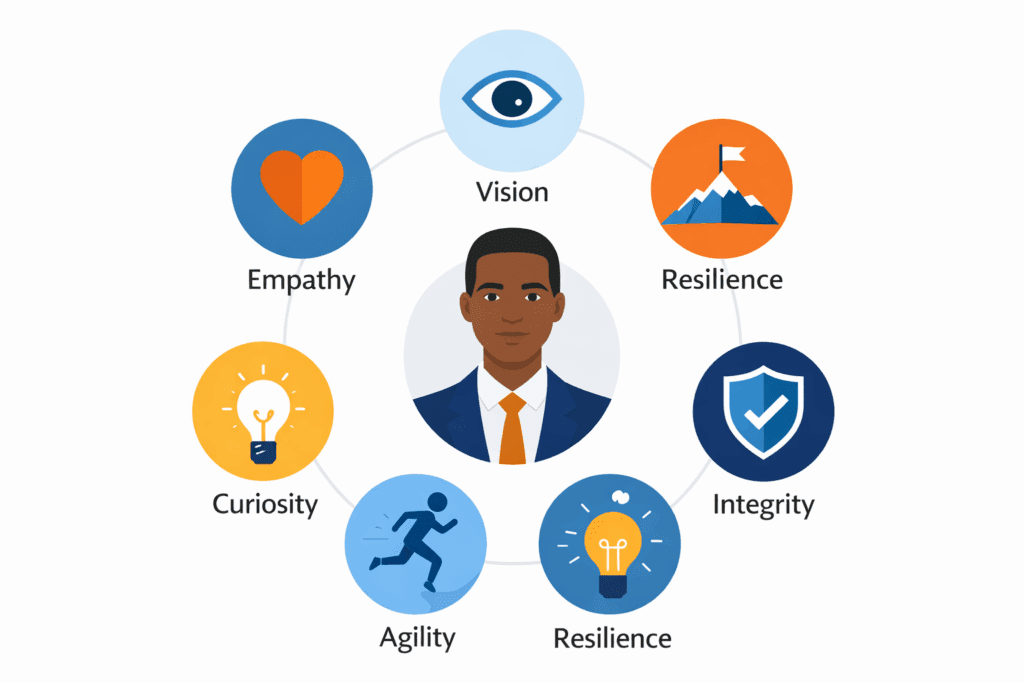
Effective change leadership is shaped as much by who leaders are as by what they do. While tools, frameworks and methodologies matter, it is leadership behavior under pressure that determines whether change gains traction or stalls. The most effective change leaders consistently demonstrate a set of core characteristics that enable them to navigate complexity, uncertainty and resistance.
Empathy and emotional intelligence
Change affects people before it affects processes or systems. Leaders with strong emotional intelligence listen carefully, acknowledge concerns and respond thoughtfully to resistance. They recognize when pushback reflects legitimate uncertainty or fatigue rather than unwillingness, and they adjust their approach accordingly.
Empathy does not mean avoiding difficult decisions. It means understanding how those decisions land with employees and providing appropriate support as people adapt. Leaders who take time to understand different perspectives build trust, which is essential for sustained change.
Flexibility across contexts
Change leadership requires moving fluidly between priorities, audiences and environments. Effective leaders can shift from enterprise-level strategy discussions to frontline conversations without losing clarity or credibility. They adapt their messaging to different functions, regions and levels while maintaining consistent intent.
Transformation rarely follows a straight line. Leaders must adjust plans based on emerging information, operational realities and stakeholder feedback while preserving alignment to strategic objectives.
Agility and learning orientation
Agile change leaders act quickly, test assumptions and learn from outcomes. They value progress over perfection and understand that waiting for certainty often means missing opportunity. Setbacks are treated as data, not failure.
This learning orientation encourages experimentation and continuous improvement across the organization. Teams are more willing to engage with change when leaders model curiosity and resilience rather than defensiveness.
Focus and prioritization
Change competes constantly with business-as-usual demands. Effective change leaders protect focus by making deliberate choices about priorities, resourcing and attention. They ensure transformation does not become an optional extra squeezed between quarterly targets and operational firefighting.
This discipline sends a clear signal about what matters. When leaders consistently reinforce priorities through decisions and behavior, employees understand that change is not temporary rhetoric but a sustained commitment.
Resilience under pressure
Change is difficult. Resistance, setbacks and fatigue are inevitable. Resilient leaders maintain momentum without denying reality. They absorb pressure, stay optimistic and help others recover when progress slows.
This resilience enables leaders to navigate criticism, manage competing expectations and persist when results take time to materialize. It also reassures employees that leadership is steady, even when the path forward feels uncertain.
Curiosity and openness
Curious leaders never assume they have all the answers. They seek input, question assumptions and look beyond their organization for insight. This openness drives innovation and prevents stagnation.
By encouraging curiosity in others, change leaders create environments where ideas surface early, risks are identified sooner and improvements are continuous rather than episodic.
Visionary thinking
Vision is central to change leadership. Effective leaders see beyond current constraints and articulate compelling future states that feel both ambitious and achievable. They balance aspiration with realism, grounding vision in evidence while refusing to be limited by the status quo.
Vision provides meaning. It helps employees understand why disruption is necessary and what the organization is working toward, creating motivation that sustains effort over time.
Energy and personal credibility
Change leadership requires visible energy. Leaders who champion change authentically generate momentum and engagement. Their enthusiasm is credible because it is grounded in belief rather than obligation.
Credibility also comes from integrity. Leaders who align words with actions, communicate honestly about challenges and follow through on commitments earn trust. That trust gives them the license to ask for significant effort and adaptation from others.
How Managers Can Lead Effectively Through Change and Uncertainty
As organizational change becomes more frequent, change leadership is no longer confined to senior executives. People managers increasingly serve as the primary interface between enterprise change initiatives and employee experience.
While managers may not define strategy, they shape how change is understood and enacted day to day. Their role focuses on helping direct reports navigate practical impacts, maintain performance and build confidence during transition. Yet many organizations acknowledge a gap here; a significant proportion of HR leaders report that managers lack the skills required to lead change effectively.
Effective people managers play several critical roles during change. They translate high-level messages into concrete implications for their teams, clarifying what is changing, when it is changing and what is expected. They reinforce priorities through daily decisions and behavior, demonstrating that adaptation is both necessary and supported.
Managers also serve as vital feedback channels. They surface concerns, resistance patterns and operational issues that senior leaders rarely see directly. This upward feedback enables faster course correction and more responsive change strategies.
Despite this importance, many managers receive little formal preparation for change leadership. Providing targeted coaching, practical toolkits and ongoing support significantly increases the likelihood that change will be adopted and sustained. Investing in manager capability is one of the most effective ways to strengthen enterprise-wide change leadership.
The Future of Change Leadership
Several trends are reshaping expectations of change leadership across industries and geographies.
Change leadership as a core leadership capability
Volatility, uncertainty, complexity and ambiguity are now permanent features of the business environment. As a result, change leadership is evolving from a specialized capability into a core leadership requirement at all levels.
Organizations can no longer rely solely on executive sponsors or specialist practitioners to carry the burden of transformation. Every leader is expected to guide teams through continuous evolution. This shift has implications for leadership development, performance evaluation and succession planning.
Organizations that take change leadership seriously assess it systematically, develop it deliberately and recognize it explicitly in promotion and reward decisions.
Human-centered leadership in digital transformation
As digital technologies and artificial intelligence drive an increasing share of organizational change, the human dimension becomes more critical rather than less. Technology initiatives fail most often due to adoption challenges, not technical shortcomings.
Change leaders must balance enthusiasm for innovation with empathy for its impact. Automation, new systems and data-driven decision-making disrupt roles, expertise and identity. Leaders who anticipate these impacts and invest in communication, training and support enable smoother transitions and stronger outcomes.
From initiative delivery to transformation leadership
The most effective change leaders increasingly think beyond individual initiatives. Rather than managing a series of disconnected projects, they take a transformation perspective, aligning multiple changes to a coherent strategic narrative.
This approach reduces change fatigue and confusion by helping employees see how initiatives connect and reinforce one another. It also enables better sequencing and pacing, ensuring that the organization absorbs change without becoming overwhelmed.
Transformation leadership requires systems thinking, orchestration skills and a strong sense of purpose. It also places greater emphasis on culture, mindset and behavior as levers of long-term performance.
The rising importance of emotional intelligence
As change becomes continuous, emotional intelligence grows in importance. Leaders must help employees build resilience, adaptability and confidence amid ongoing uncertainty. Supporting well-being is no longer separate from driving performance; the two are closely linked.
Leaders who demonstrate empathy, authenticity and presence create environments where people are more willing to engage with change and less likely to disengage or exit.
Embracing the Change Leadership Imperative
Change leadership is demanding for those experiencing transformation and for those responsible for driving it. The skills required extend beyond traditional management into vision-setting, emotional intelligence, strategic communication and sustained resilience.
Organizations face a clear reality. The quality of change leadership predicts outcomes more reliably than the sophistication of strategy, technology or funding. Weak change leadership undermines even well-designed initiatives. Strong change leadership can recover momentum even when conditions are difficult.
The encouraging news is that change leadership is learnable. Leaders can build capability through deliberate practice, feedback and development. Organizations can assess readiness, invest in skill-building and create conditions where effective change leadership becomes the norm rather than the exception.
Leaders who commit to strengthening their change leadership capability position their organizations for long-term success. They guide teams through uncertainty with clarity and confidence, shaping the future rather than reacting to it.
Contact Us
Building these capabilities takes more than theory. Our Change 101 Bootcamp gives leaders practical tools, a shared language, and hands-on experience they can apply immediately to lead change with greater confidence and consistency.
For organizations seeking coaching and advisory support to develop their change leaders, our team of experienced business, change and domain leaders is ready to help.
Change Leadership Frequently Asked Questions
Change leadership is the ability to set direction and mobilize an organization through transformation. It focuses on defining why change is necessary, where the organization is headed and how leaders must behave to make that future real.
Unlike change management, which concentrates on execution mechanics, change leadership is about vision, belief and momentum. Effective change leaders act as visible sponsors, aligning strategy, culture and leadership behavior. They create urgency, build commitment across the organization and sustain focus from initiation through long-term adoption.
At its core, change leadership ensures transformation is not treated as a temporary project but as a strategic priority that shapes how people think, work and make decisions.
Leading through change is one of the most demanding responsibilities placed on senior executives. Organizations that lack the ability to evolve struggle to outperform competitors, and even market leaders can quickly lose relevance. Competitive pressures shift, technology cycles shorten, regulatory landscapes change and customer expectations advance faster than most operating models were built to accommodate. Across organizations that manage this complexity well, one factor consistently differentiates success from stagnation: change leadership.Change management and change leadership serve different but complementary purposes.
Change management focuses on execution. It addresses how people adopt and use change through structured planning, communication, training and measurement. Change practitioners, project managers and managers work together to manage impacts, track adoption and reduce resistance. It functions as the map: guiding teams through the steps required to implement change.
Change leadership focuses on direction and commitment. It defines why the change matters, what future state the organization is working toward and how leaders must behave to support it. Senior leaders provide visible sponsorship, align priorities and shape culture. This is the compass: setting direction and maintaining alignment.
The distinction is practical. Change management ensures change is implemented well. Change leadership ensures the right change is being pursued and taken seriously. Sustainable transformation requires both.
Managers play a decisive role in how change is experienced day to day. They lead effectively through five core practices:
-
Communicate consistently by translating enterprise messages into clear implications for their teams. Employees trust direct managers most when it comes to understanding how change affects their work.
-
Role-model new behaviors by adopting changes early and visibly. Teams take cues from what managers do, not just what they say.
-
Provide support by acknowledging the emotional impact of change while offering practical help such as coaching, training and access to resources.
-
Create feedback loops by surfacing concerns, resistance patterns and implementation issues to senior leaders so adjustments can be made quickly.
-
Maintain focus by protecting change priorities from being crowded out by operational pressures.
Many managers require targeted support to fulfill these responsibilities effectively, particularly as change becomes more frequent and complex.
A change leader fulfills five essential roles:
-
Strategic sponsor: authorizes transformation, allocates resources and removes obstacles through active, visible involvement.
-
Vision communicator: explains why change is necessary, how it connects to strategy and what it means for different stakeholder groups.
-
Coalition builder: aligns leaders, managers and employees across functions and levels to create shared ownership.
-
Behavior model: demonstrates new ways of working first, signaling that adaptation is expected and supported.
-
Culture catalyst: drives the mindset and behavior shifts required to embed change beyond technical implementation.
The defining responsibility of a change leader is accountability for outcomes. They ensure transformation delivers strategic value and becomes part of how the organization operates.
Effective change managers combine technical expertise with strong people skills.
Key capabilities include:
-
Methodological expertise in change frameworks such as ADKAR, Kotter or Prosci, including readiness assessment, stakeholder analysis and adoption measurement.
-
Clear communication skills that translate complex strategies into actionable plans and messages for different audiences.
-
Empathy and emotional intelligence to recognize how change impacts individuals and teams and to provide appropriate support.
-
Analytical rigor to use data to track progress, identify gaps and demonstrate value.
-
Influence without authority, enabling them to coach sponsors and engage stakeholders across organizational boundaries.
-
Adaptability to adjust tactics based on evidence and feedback while staying aligned to strategic intent.
Strong change managers bridge the gap between leadership vision and operational reality, turning intent into sustained behavior change.
Microsoft’s transformation under Satya Nadella is a widely cited example of effective change leadership.
When Nadella became CEO in 2014, Microsoft faced declining relevance and an internally competitive culture. He established a clear strategic direction centered on cloud computing and articulated a cultural shift from a “know-it-all” mindset to a “learn-it-all” mindset, tied to the company’s purpose of empowering people and organizations.
Nadella personally modeled this shift by embracing vulnerability, acknowledging mistakes and reinforcing learning as a leadership expectation. He aligned leadership incentives, restructured performance management and maintained consistent focus on strategic priorities such as Azure and Teams.
The results were sustained and measurable: significant growth in market value, a leading position in cloud services and improved employee engagement.
The lesson is clear. Successful change leadership combines clear direction, visible role modeling and disciplined execution to achieve lasting transformation.
