


How to Develop Leadership Teams That Deliver Alignment, Capability, and Performance
Many organizations put meaningful budget into growing individual leaders. Far fewer invest in the leadership team as a working unit, and that gap is where we have seen change programs lose traction most often. The pattern shows up repeatedly across transformation work: strong individual executives do not automatically create effective collective leadership.
Leadership team development belongs in every mature organization, particularly when major change is underway. Development budgets often concentrate on more junior employees, yet highly skilled and experienced people need focused growth as well. Physicians are highly trained professionals, and they complete regular development to stay effective. Business conditions shift faster than most medical practice areas, so senior leaders need a regular development rhythm too.
This insight explores leadership team development in the context of organizational change, covering:
- What leadership team development is
- Why leadership team development matters during change
- What effective leadership teams do differently
- How to build an effective leadership team development strategy
- When to use a leadership framework
- The role of leadership team development in sustaining change
- Common mistakes we have seen in leadership team development
What is Leadership Team Development?
Leadership team development is the disciplined process of improving how leaders operate together, and how that work connects to a broader approach to organizational change. It reaches beyond individual coaching or skills training to build a high-performing leadership system, where decisions are timely, communication is consistent, accountability is shared, and alignment holds under pressure. In practice, this is where we often see the gap between leadership intent and execution start to appear.
The distinction from individual leadership development matters. A leadership team can be filled with capable people and still underperform when those people move in different directions, work in functional silos, or send inconsistent messages to their organizations.
Core focus areas in leadership team development include:
- Collective decision-making, including how it is structured and delegated
- Alignment around shared priorities and change objectives
- Consistent communication across functions and organizational levels
- Shared accountability for business outcomes, beyond individual performance
- Trust and transparency within the team itself
- Measurement of leadership behaviors and team performance over time
Handled well, leadership team development becomes a core transformation capability.
Why Leadership Team Development Matters More During Change
Change Exposes Leadership Misalignment
Organizational change strips away many of the routines and structures that allow misalignment to stay hidden. We see this most clearly during transformation, when misalignment that once felt manageable becomes visible and begins to slow delivery. When processes are stable, leaders can operate with a degree of separation and the organization may still function adequately. Once change is introduced, whether through restructuring, culture change, digital transformation, or a merger, that separation becomes visible and expensive.
Competing priorities come to the surface. Inconsistent behaviors confuse employees. Leaders who seem aligned in the executive meeting send conflicting signals in the field. Change slows, resistance grows, and the credibility of the program is weakened before it has gained momentum.
Change Requires a Collective Behavior Shift
Sustained change does not depend on one exceptional leader. It depends on a leadership team that collectively models the behaviors the change requires. If the change asks the organization to become more collaborative, more agile, or more customer-centric, those behaviors need to be visible first in the way the leadership team operates.
Leadership team development creates the shared language, agreed ways of working, and mutual accountability that enable a leadership team to lead change consistently, across the enterprise.
The Cost of Getting It Wrong
The consequences of neglecting leadership team development during change are measurable. In our experience, this is often where organizations are pulled into reactive course correction instead of maintaining momentum through the change. Change fatigue rises when employees hear mixed messages from different parts of the leadership group. Frontline and middle managers lose confidence when they cannot see a clear direction from the top. High-potential talent disengages when leaders behave in ways that conflict with the stated values of the change.
The cost of rescuing a struggling change program is far greater than the cost of developing the leadership team that could have delivered it with confidence.
What Effective Leadership Teams Do Differently
Organizations that sustain change over time tend to show a consistent leadership pattern. Across the organizations we work with, these behaviors show up in teams that carry change through to business outcomes. Effective leadership teams maintain a shared understanding of where the organization is heading and why. They make decisions with clarity about what needs collective input and what can be delegated. They align on a consistent message before engaging the wider organization. They build psychological safety within the team, so challenge and difficult trade-offs are handled at leadership level before they become organizational issues. They also sustain those behaviors throughout the full change program, beyond launch activity.
In a 2022 study published in the International Journal of Environmental Research and Public Health, analyzing 1,150 leaders across 160 management teams, researchers found that psychological safety improves team effectiveness through its impact on behavioral integration. Teams where leaders felt safe to speak openly showed higher levels of collaboration, information sharing, and shared ownership of decisions, all of which were associated with stronger overall performance. See the full study.
These behaviors can be learned and developed. They are exactly the behaviors leadership team development is designed to build.
Seen in Practice: Aligning Leadership Before Transformation

Leadership team development is often most valuable before major change begins. The experience of an energy business preparing for a global SAP S/4HANA implementation illustrates why. Although the organization had been acquired by a global oil and gas group in 2013, by 2022 it was still operating semi-autonomously. The ERP program was positioned as a catalyst for enterprise transformation, yet the leadership team had not aligned on the scope, ambition, or purpose of the change.
A six-week pre-discovery phase was established, anchored at Executive Leadership level, with validation from operational stakeholders and colleagues across the business. Across 20 engagement touchpoints, including one-on-one conversations and smaller group sessions, leaders were supported in exploring whether the organization needed full future-state business transformation or a more focused ERP-led change and adoption approach.
By the end of the intervention, the Executive Leadership team had agreed the type of change needed, why it mattered, when it needed to happen, and what discovery needed to achieve. Key risks had been identified early, giving the organization a clearer scope, stronger decision-making parameters, and a more confident foundation for the next phase of transformation.
How to Build an Effective Leadership Team Development Strategy
Start with a Clear Outcome
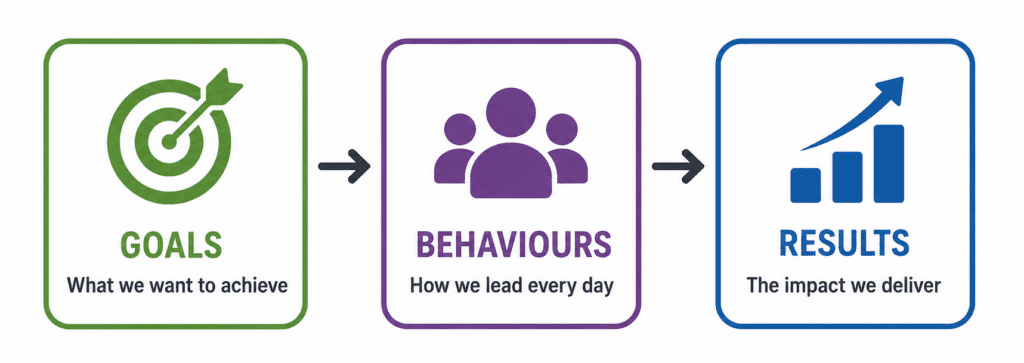
A leadership team development strategy should start with clarity about what the change requires from the leadership team collectively. This is where we typically begin with clients, aligning leadership teams on outcomes before designing any development intervention. The critical work is to define which behaviors, decisions, and communications will determine whether the change gains adoption or stalls. Development that is disconnected from a clear organizational outcome becomes an investment with limited return.
Continuously Assess Capability
Leadership capability needs to evolve alongside the demands of the change. Ongoing assessment is a consistent feature of the programs we support, helping capability keep pace with the change itself. Continuous assessment across the change lifecycle identifies emerging gaps and surfaces barriers before they become critical. This means assessing team-level dynamics and decision-making patterns, along with individual skills. Regular feedback and performance data guide targeted interventions and keep development relevant as the program evolves.
Assess leadership readiness
Wondering whether your leadership team is equipped to lead change successfully? Our free Change Readiness Assessment identifies strengths, uncovers risks and helps you understand where to focus development efforts.
Define the Behaviors That Matter, Then Resource Accordingly
The priority is to define the specific leadership behaviors the change requires and to build a program that develops them directly. Organizations then need to make a clear assessment of whether internal capability exists to own that program, or whether an external partner would bring the expertise and perspective to deliver it more effectively. External specialists add particular value when the change requires a significant shift in leadership culture or when embedded patterns need to be challenged with fresh perspective.
Integrate Development with the Change Journey
A leadership development strategy that runs alongside a change program without being integrated into it will underdeliver. When it works well, development becomes part of delivery rather than an adjacent activity. Development needs to be sequenced with the change: building capability before key milestones, reinforcing behaviors during critical phases, and reviewing progress as the program evolves.
Do You Need a Leadership Framework?
A leadership framework can give structure to leadership team development by defining the behaviors, capabilities, and expectations required to lead effectively. In practice, we see organizations use a mix of approaches, with the strongest frameworks grounded in their specific change context instead of applied as a generic template.
The framework matters because of what it enables. Effective frameworks help leadership teams assess current capability, identify gaps, and focus development on the behaviors most critical to successful change.
Whether organizations use a competency-based model, a values-led approach, or a bespoke framework designed around their strategic objectives, the goal is consistent: building the collective leadership capability needed to deliver change successfully.
Types of Leadership Development Frameworks
There is no universal approach to creating a leadership development framework, and the best option is the one that suits your change program.

Several common types can provide a useful starting point:
Competency-based: Competency frameworks, for example the leadership pipeline model, identify the key skills and behaviors required at each leadership level within an organization so they can be developed deliberately.
Values / purpose-based: Ethical leadership and purpose-driven leadership frameworks emphasize the importance of aligning leaders’ actions with the organization’s values and broader sense of purpose.
Theory-based: These frameworks are built on proven leadership theories, for example transformational, situational, and servant leadership. These different perspectives on effective leadership approaches can form the foundation for a leadership development framework.
Building and Maintaining Your Framework
Before change, a capability assessment identifies the gap between current leadership capability and what the change requires, covering both individual and team-level competencies. This shapes a development program that is targeted and directly connected to the demands ahead.
During change, the framework should remain a live tool. Every initiative that flows from it should be tested against the strategic goals of the change.
After change, the framework must be reviewed and updated to reflect what the organization has learned and the new demands it faces. Leadership feedback and performance data should inform each cycle.

The Role of Leadership Team Development in Sustaining Change
Leadership team development connects strategy to execution. The gap between strategic intent and operational reality is almost always a leadership gap, and collective capability is what closes it.
It enables consistent behavior at scale. An organization changes when its people change their behaviors, and that process starts at the top. When leadership teams model the required behaviors consistently, the rest of the organization has a credible example to follow.
It supports succession planning. A strong development strategy builds a pipeline of leaders who understand the direction of the business, have been developed against a clear framework, and are ready to step into critical roles as needs arise. This reduces dependency on external hires and protects the culture the organization is working to build.
It also strengthens long-term change capability. Leadership teams that have been developed through change become faster, more decisive, and more resilient when the next change arrives. That is the compounding return on investment in leadership team development.
Mistakes We’ve Seen in Leadership Team Development
Across the leadership teams we work with, the same challenges appear repeatedly. These are practical gaps we see limiting leadership impact during change.
Over-investing in Individual Leaders
Focusing only on individual leaders is the most common mistake. Individual capability is necessary, though it will not deliver collective performance on its own. Unless the team functions as a unit, individual excellence does not translate into shared impact.
Treating Development as a One-time Intervention
Treating development as a one-time program creates a short-term lift without lasting change. Sustainable capability requires sustained investment, reinforcement, and review throughout the full arc of a change program.
Ignoring Team Dynamics and Collective Behaviors
Prioritizing technical skills while ignoring team dynamics and behaviors misses the primary driver of leadership team performance. How leaders interact, challenge each other, and maintain accountability under pressure determines outcomes more than any single individual competency.
Applying Generic Frameworks without Context
Heavy reliance on generic frameworks produces development that feels detached from the real challenges of the business. The most effective frameworks are grounded in the specific context, culture, and strategic demands of the organization.
Failing to Reinforce and Sustain Change
Weak reinforcement after the initial intervention is where much of the development investment is lost. Development without a reinforcement plan is incomplete by design.
Why Leadership Team Development Cannot Be an Afterthought
Leadership team development is a strategic necessity for forward-thinking and mature organizations, especially those implementing a change program. Robust development will help leaders navigate the challenges of change, overcome self-perceptions and nurture future talent.
However, building a leadership development strategy requires a commitment to aligning it with your change, constantly assessing it and a willingness to leverage internal and external expertise. A more structured approach can be taken by creating a well-defined leadership framework, built on proven models to ensure it is both comprehensive and adaptable.
Build leadership capability that delivers change
We’ve delivered this with leadership teams facing real change, and it works. Our Change 101 Bootcamp builds the shared tools, language and behaviours leaders need to lead change consistently in practice, delivered through immersive, scenario-based workshops that our clients love
FAQs: Leadership Team Development
Leadership team development is the process of improving how a group of leaders operates collectively. It focuses on building shared alignment, effective decision-making, consistent communication and mutual accountability across the leadership team, rather than developing individual leaders in isolation.
Organizations succeed or fail at change based on how well their leadership teams function as a unit. Even highly capable individual leaders will underdeliver if they are misaligned, operating in silos or communicating inconsistently. Leadership team development addresses those collective dynamics directly.
Developing a leadership team begins with a clear assessment of current capability at both individual and team level. It requires a strategy aligned to the organization’s change objectives, a structured framework that defines the required behaviors and competencies, and ongoing reinforcement to embed and sustain the behaviors developed.
Leadership development focuses on building the capability of individual leaders. Leadership team development focuses on how leaders function together: how they align, decide, communicate and hold each other accountable. Both matter, but the team dimension is frequently neglected and is often the more critical lever during organizational change.

