


Change Models: How to Select, Blend and Apply Them Effectively
Leaders searching for change management models usually expect a familiar catalog. Prosci ADKAR, Kotter’s 8-Step Change Model, Lewin’s Three-Stage Model, Bridges’ Transition Model and the McKinsey 7-S Framework appear on nearly every list, and those lists serve a purpose (and you can read our own at the end of this article!). Models create structure when transformation feels fluid, and they offer shared vocabulary at moments when teams feel overwhelmed. But their deeper value comes alive through how leaders carry them into the organization.
As companies integrate new technologies, redefine operating models and revisit business priorities, the human experience of change holds the greatest sway. Alignment, trust, emotional readiness and cultural clarity influence outcomes long before methodology does. Change management models give shape to the work, however people create the shift.
This Insight connects those two ideas. It explains the practical mechanics leaders look for while also exploring the lived realities that determine whether any model becomes meaningful in practice.
Why Change Management Models Matter
Change management models translate complexity into something usable. They turn high-level ambition into steps, behaviors and sequences that people can recognize. They keep programs from drifting and anchor conversations in a shared direction. The true advantage comes from how teams apply them.
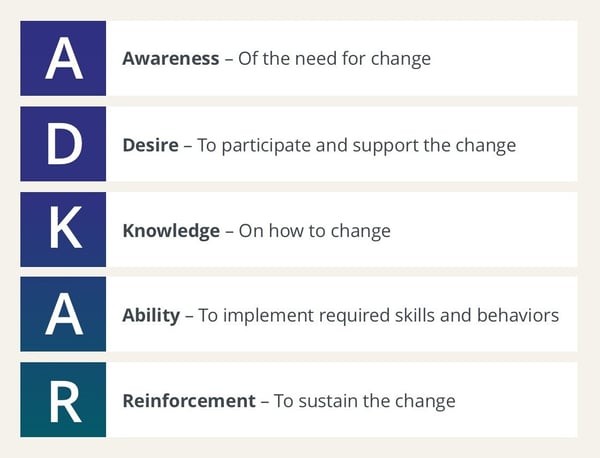
Prosci ADKAR remains one of the clearest examples. It is familiar, understandable and portable across a wide range of functions. It creates order when uncertainty grows. Members of project teams and executive sponsors can describe it with ease, and that accessibility strengthens its influence.
Large transformational shifts sometimes require additional structure. Incorporating elements from Kotter’s 8-Step Model, such as a guiding coalition or a clear sense of urgency, reinforces leadership alignment and commitment. These complementary layers strengthen momentum and signal accountability.
These experiences shaped how I use change management models. They provide an essential compass, and their impact deepens when paired with strong leadership and genuine connection. The model sets direction; people carry the journey.
Applying Models Thoughtfully
Change management models are organized and structured. People are variable. The blend requires judgment.
A model delivers value when it supports people through uncertainty, not when it becomes a checklist. During one SAP implementation at a major fashion retailer, a consulting team conducted ADKAR readiness assessments with clipboards in hand. They asked employees whether they were aware or whether training existed, then marked each answer as a simple yes or no. Little attention was paid to understanding, capability or confidence. Employees felt that the process was procedural rather than supportive. The approach created distance rather than connection.
The issue had nothing to do with ADKAR itself. The model remained sound. The way it was used diminished its potential. When people feel heard, informed and supported, any framework becomes an enabler rather than a formality.
Different Change Management Models
Most change management models align with one of three broad categories. Each offers a different lens that helps leaders interpret the transformation ahead.
Process-based models
Lewin’s Three-Stage Model, Kotter’s 8-Step Process and PDCA guide the sequence of change. These are particularly useful in large organizations where coordinated planning, pacing and stability are essential. They help teams understand what happens when and how the organization will move from one stage to the next.
People-focused models
ADKAR, Bridges’ Transition Model and the Kübler-Ross Change Curve center on communication, motivation and emotional impact. These models support messaging, capability building and the adoption process. They help leaders understand how employees move through change internally and what support they need at each stage.
Systems or organizational models
The McKinsey 7-S Framework and the Burke-Litwin Model help diagnose alignment across strategy, structure, culture, leadership and systems. These frameworks matter when organizations face a major redesign or when multiple levers must shift simultaneously to make the change sustainable.
Understanding these categories clarifies which model fits the work ahead. Most transformations require elements from all three, though the proportions differ. The right approach begins by selecting the lens that matches the challenge.
Want to know more about the most common models? Read our useful guide demonstrating their focus, elements, strengths, considerations and best-fit scenarios, plus a comparison table for quick reference. Go to the bottom of the page to get this.
Choosing the Best Change Management Models
An effective strategy begins with context. Leaders diagnose before selecting any model.
When I begin a transformation, I do not reach immediately for a preferred model. Instead, I look at the type of change underway. ADKAR supports system implementations well because the steps are clear and measurable. Organizational restructures or cultural shifts require stronger emphasis on leadership, engagement and emotional navigation. Kotter’s ideas around shared urgency and coalitions often support these scenarios effectively.
The nature of the work guides the choice. The model must match the environment, the timeline and the people involved.
A practical decision guide can look like this:
• Incremental process improvements benefit from Lewin or PDCA when stability and repeatability matter.
• Behavioral or cultural shifts align more naturally with ADKAR or Bridges, which reflect emotion and mindset.
• Enterprise-wide transformation requires a blended structure, combining Kotter’s leadership focus, ADKAR’s individual adoption and systems thinking from McKinsey 7-S.
• Continuous or adaptive change often thrives under Agile Change Management principles where iteration and collaboration drive progress.
The objective is clarity. Change management models should guide, not constrain. The context deserves more weight than the model itself.
When to Flex the Model
There are moments in any program when the model alone cannot overcome underlying issues. In several global organizations, ADKAR language was well established and widely recognized, yet leadership alignment lagged. Competing views on direction and pace disrupted progress. No model compensates for misalignment at the top. When leaders are not unified, the change slows or stops altogether.
When this occurs, the fundamentals matter most. Leaders return to basics:
• Align leadership
• Build trust
• Clarify the narrative
• Strengthen ownership across a coalition
• Adapt the model while keeping its core intact
Experienced practitioners know that flexibility matters. Leaders want confidence that any customization still sits on a structured foundation. The risk when blending models comes from appearing improvised or unclear. Transparency and rationale protect credibility.
Blending Models
Blending change management models reflects the complexity of modern transformation. It is less about compromise and more about matching tools to reality.
Effective blends include:
• ADKAR for personal adoption combined with Kotter for leadership mobilization
• McKinsey 7-S for diagnosing structural issues followed by Agile sprints to deliver targeted improvements
• Bridges’ Transition Model supported by behavioral nudges to guide teams through uncertain phases
Each model offers a defined shape. The skill comes from layering those shapes to match the environment.
Discipline is essential when combining approaches. Clarity prevents confusion. Leaders need to understand why elements were chosen and how they reinforce one another. Without that explanation, blending can look fragmented.

What I Learned the Hard Way
My early use of change management models came with several lessons.
Underestimating Awareness
Teams often jump straight to training, the Ability phase of ADKAR, while Awareness remains fragile. Awareness is the anchor. Without understanding the purpose and implications of a change, teams cannot engage effectively.
Treating models as linear
Models like ADKAR appear linear; real transformation is not. Awareness resurfaces repeatedly. New employees join, stakeholders rotate and priorities evolve. A well-established Awareness foundation allows teams to enter the journey smoothly without constant resetting.
Missing reinforcement
Change practitioners often exit a program before reinforcement begins. Reinforcement determines whether the change holds. Building reinforcement capacity into internal teams ensures sustainability long after external support steps away.
Being precise with language
The Desire element in ADKAR refers to willingness rather than preference, yet the wording can sound insensitive during difficult transitions. In moments involving layoffs or major uncertainty, shifting the conversation toward commitment rather than desire respects the emotional reality and supports trust.
These lessons strengthened my application of change management models and reinforced the value of empathy in challenging moments.
The Human Reality Beyond Any Model
Change management models provide structure. They do not capture the full emotional landscape. Organizational restructures, for example, cannot be approached with a checklist. When people face uncertainty about their future, they need more than a framework. They need clarity, respect and human connection.
As technology advances and AI shapes more operational processes, empathy remains essential. Change is always experienced on a personal level. People interpret it through their own concerns, hopes and circumstances. Leadership must recognize this dynamic to create conditions where adoption becomes possible.
Where Practitioner Experience Strengthens Models
If I created a new model today, it would account for change fatigue. Most models assume a reset or fresh beginning. Employees rarely start change from scratch. They carry the memory of previous initiatives – 5x more initiatives than 10 years ago. They remember where plans stalled or where value never surfaced.
Employees often adopt a wait-and-see posture. It is understandable since many have seen programs fade before delivering expected benefits. That pattern influences engagement long before training begins.
A strong change strategy earns commitment gradually. It shows consistency. It celebrates progress early and shares evidence that the work is moving forward. This type of reinforcement reduces fatigue and encourages belief in the process.
The Future of Change Management Models
Change management models continue to evolve. Data, analytics and AI will not replace them, although they will reshape how we use them.
Data-informed change
Real-time insights reveal readiness, sentiment and adoption at a pace that was impossible in the past. Leaders can identify issues earlier and intervene with precision. This matters, especially since many organizations still struggle to define success metrics for change.
Behavioral science
Neuroscience and psychology contribute to better design of change experiences. They improve understanding of how people make decisions and how habits form.
AI-assisted transformation
AI provides pattern recognition, identifies resistance and highlights opportunities for targeted support. It does not replace judgment; it enhances it.
Continuous capability building
Organizations are shifting from episodic change to continuous adjustment. This requires long-term capability, where change literacy becomes part of culture.
Models will remain valuable, though they will become lighter, more adaptive and increasingly centered on human experience.
The Model Is Not the Change
Change management models provide structure, language and clarity. They offer a strong starting point. Their effectiveness depends on how leaders use them and how people experience the journey.
Anchor your approach in a model. Use it consistently. Adjust it when the environment shifts. Blend approaches when the change calls for it. Keep people at the center of every step.
As organizations adopt more advanced technologies, the human dimension becomes even more important. Leadership alignment, cultural clarity and empathy determine the ultimate value of any transformation.
Start with people. Let the model support them.
Contact the team
I would welcome a conversation about your upcoming initiatives and explore which change management models can support your plans.
12 Types of Change Management Model Explained
What are change management models? Find out with our model-by-model breakdown and handy comparison table for quick reference.
Prosci ADKAR Model
Focus: Individual change that builds from the ground up.
Elements: Awareness → Desire → Knowledge → Ability → Reinforcement.
Strengths: Easy to understand, people-centered and adaptable, with strong emphasis on sustaining change.
Considerations: Can feel sequential and narrow when addressing system-wide transformation, with attention centered more on outcomes than processes.
Best for: Incremental or people-driven initiatives and building adoption capability.
Lewin’s 3-Step Model
Focus: Structured transition through process change.
Elements: Unfreeze → Change → Refreeze.
Strengths: Straightforward and intuitive, supports reflection and feedback loops.
Considerations: Oversimplifies complex transformations and offers limited process detail.
Best for: Smaller-scale improvements and operational process shifts.
Kotter’s 8-Step Model
Focus: Organization-wide transformation shaped by strong executive direction.
Elements: Urgency → Coalition → Vision → Volunteer Army → Remove Barriers → Short-term Wins → Sustain Acceleration → Institute Change.
Strengths: Clear, leadership-oriented roadmap that builds momentum.
Considerations: Can become overly rigid or top-down, with less opportunity for employee co-creation.
Best for: Enterprise transformations with committed sponsorship.
Kübler-Ross Change Curve
Focus: Emotional progression through disruption.
Elements: Denial → Anger → Bargaining → Depression → Acceptance.
Strengths: Centers emotional realities and strengthens empathetic communication.
Considerations: Experiences vary widely and the model is not linear; offers few tools for implementation.
Best for: Situations involving high emotional impact or sensitive transition periods.
McKinsey 7-S Model
Focus: Alignment across interconnected organizational systems.
Elements: Strategy, Structure, Systems, Shared Values, Style, Staff, Skills.
Strengths: Holistic view that identifies misalignment and cross-functional gaps.
Considerations: Analytical and heavily diagnostic; requires supplemental methods for execution.
Best for: Strategic, enterprise-level redesigns or major planning cycles.
Nudge Theory
Focus: Supporting behavioral change through subtle guidance.
Elements: Define the change, view it from the employee perspective, present options, gather feedback, reinforce progress.
Strengths: Behavioral science foundation, encourages autonomy and engagement.
Considerations: Harder to scale to large transformations and can be difficult to measure; risks misinterpretation if applied poorly.
Best for: Cultural or behavioral shifts that benefit from subtle influence.
Bridges’ Transition Model
Focus: Psychological journey during change.
Elements: Ending, Losing & Letting Go → Neutral Zone → New Beginning.
Strengths: Centers emotional adaptation and employee engagement.
Considerations: Conceptual and broad, without step-by-step implementation guidance.
Best for: Human-centered changes or periods with meaningful emotional impact.
Satir Change Model
Focus: Emotional progression and resulting performance dips.
Elements: Late Status Quo → Resistance → Chaos → Integration → New Status Quo.
Strengths: Acknowledges turbulence and helps prepare teams for performance variability.
Considerations: Descriptive and time-intensive, with limited operational tools.
Best for: Guiding teams through disruptive transitions and managing morale.
Maurer’s 3 Levels of Resistance
Focus: Root causes of resistance.
Elements: “I don’t get it.”, “I don’t like it.”, “I don’t like you.”
Strengths: Highlights the role of communication and trust; clarifies interpersonal dynamics.
Considerations: Not a full framework and often reactive; requires strong relationship skills to apply.
Best for: Diagnosing and addressing resistance during ongoing work.
Deming Cycle (PDCA)
Focus: Continuous improvement through iteration.
Elements: Plan → Do → Check → Act.
Strengths: Promotes learning and consistent refinement; reduces risk through steady cycles.
Considerations: Can feel slow or too incremental for large transformations; incorporates fewer people-focused elements.
Best for: Operational optimization and mature continuous improvement environments.
Burke-Litwin Model of Organizational Performance & Change
Focus: System-wide relationships between internal and external forces.
Elements: Twelve diagnostic components from External Environment to Individual Motivation.
Strengths: Highly comprehensive and effective for identifying cause-and-effect patterns.
Considerations: Analytical and complex; can feel heavy for smaller initiatives.
Best for: Complex organizational redesign and cultural or structural transformation.
Agile Change Management Model
Focus: Iterative, collaborative change for dynamic conditions.
Elements: Flexibility, collaboration, minimal overplanning, rapid feedback and continuous learning.
Strengths: Highly responsive, encourages adaptation and teamwork, well suited for evolving priorities.
Considerations: Requires a mature agile culture and may overlook emotional or individual-level impact.
Best for: Digital transformation or rapid, fast-moving environments.
| Model | Primary Focus | Key Strengths | Main Considerations | Best For |
|---|---|---|---|---|
| Prosci ADKAR | Individual adoption | People-centered, simple, adaptable, supports long-term sustainment | Can feel linear, limited system-level scope | Incremental or people-focused change and building adoption capability |
| Lewin’s 3-Step Model | Process transition | Clear and intuitive, supports reflection and feedback | Oversimplifies complex change, minimal structural detail | Smaller process-driven or operational changes |
| Kotter’s 8-Step Model | Organization-wide transformation | Strong leadership structure, momentum-building | Can be rigid and top-down, limited co-creation | Enterprise transformations with strong executive sponsorship |
| Kübler-Ross Change Curve | Emotional experience of change | Empathetic, highlights emotional responses | Non-linear, offers fewer implementation tools | Sensitive or emotionally charged change |
| McKinsey 7-S Framework | Organizational alignment | Holistic, reveals system-wide misalignment | Analytical and complex, needs complementary execution methods | Large strategic transformations and organizational diagnostics |
| Nudge Theory | Behavioral influence | Grounded in behavioral science, encourages autonomy | Hard to scale, difficult to measure, may be misinterpreted | Cultural or behavioral change initiatives |
| Bridges’ Transition Model | Psychological transition | Emotionally intelligent, engagement-focused | Conceptual with limited process guidance | Human-centered change involving emotional impact |
| Satir Change Model | Emotional and performance progression | Highlights morale dips, prepares teams for disruption | Descriptive, time-intensive, less operational | Disruptive change requiring resilience and performance support |
| Maurer’s 3 Levels of Resistance | Reasons for resistance | Improves trust and communication, clarifies interpersonal barriers | Not a full framework, reactive, requires relational skill | Diagnosing and addressing resistance during active change |
| Deming Cycle (PDCA) | Continuous improvement | Iterative, structured, supports learning and refinement | Slower for large change, less people-focused | Operational improvement and continuous refinement |
| Burke-Litwin Model | Organizational dynamics | Comprehensive, strong cause-and-effect analysis | Analytical and heavy for smaller initiatives | Complex redesigns and deep cultural transformation |
| Agile Change Management | Adaptive, iterative change | Responsive, collaborative, built for shifting priorities | Requires mature agile culture, less focus on emotional factors | Digital or fast-moving business transformation |

