


A Practical Guide to a Training Needs Assessment
A training needs assessment gives leaders a clear view of the barriers affecting performance. Those barriers may involve capability, confidence, processes, leadership, technology, or change readiness. A strong assessment shifts attention from course enrollment to the practical support employees need to produce priority business results.
This guide explains the purpose of a training needs assessment, the right time to conduct one, how to organize it across three organizational levels, and how to evaluate whether the selected intervention improves performance. It is designed for leaders responsible for transformation, workforce capability, or operational improvement. Training may contribute to the solution; the evidence should determine its role.
The practical payoff from a training needs assessment comes through sharper decisions. Leaders can prioritize investment, select the support employees need, and connect capability initiatives to operating performance, adoption, and transformation goals. The resulting evidence also gives sponsors a clear basis for approving, sequencing, or declining proposed learning investments.
What Is a Training Needs Assessment
A training needs assessment (TNA) is a structured process that identifies the distance between current results and the performance an organization requires to meet its goals. The process gathers evidence about obstacles affecting employees, teams, and the broader enterprise, then translates those findings into recommended interventions. Depending on the objective, its scope can cover one role, a business unit, or the entire workforce.
Organizations use a TNA to ground capability investments in evidence. The assessment tests an apparent skills gap before resources are committed to a course or curriculum. Its central purpose is to identify the cause of the performance constraint and establish whether training is an appropriate response.
A complete assessment examines three levels, with each level informing a different performance decision:
| Assessment Scope | Decision to Inform | Common Evidence |
| Organization-wide | Capability alignment with business strategy | Corporate strategy, workforce plans, emerging skills |
| Team / Operations | Ability of current workflows to support performance | Process maps, KPIs, operational results |
| Individual | Employee knowledge, skills, and confidence | Surveys, evaluations, interviews |
Each level produces distinct evidence and can lead to a different solution. An individual-only review may miss obstacles created by the team environment or the organization. A closer look at all three levels appears later in this guide.
For example, low adoption after a system launch can initially appear to be a training issue. A broader assessment may find that employees understand the platform, managers provide limited reinforcement, teams rely on inconsistent workarounds, and performance measures continue to reward the former process.
These terms are frequently used interchangeably, but they are not the same exercise. A skills gap analysis focuses narrowly on missing knowledge or skills within a role or team. It answers a fairly contained question: what do people need to know or be able to do that they currently cannot.
A training needs assessment goes wider. It considers performance data, working conditions, leadership support, process design and change readiness alongside skills and it recommends solutions rather than simply confirming a gap. A skills gap analysis can sit inside a TNA as one source of evidence; a TNA is rarely satisfied by a skills gap analysis alone.
In most organizations, these two phrases describe the same overall activity and the distinction is more technical than practical. Assessment typically refers to the process of gathering evidence: data collection, surveys, interviews, performance metrics. Analysis refers to the interpretation of that evidence: identifying patterns, root causes and priorities.
A learning needs assessment is closely related to a training needs assessment, and the terms are sometimes used interchangeably. The difference is usually one of emphasis: a TNA identifies performance gaps and tests whether training is the right response, while a learning needs assessment focuses on what people need to learn or develop.
That learning may include formal training, but also coaching, mentoring, self-directed learning or on-the-job practice. The key is to link any learning need to business outcomes rather than treating it as a standalone course requirement.
Why Training Cannot Resolve Every Performance Gap
A frequent workforce development mistake is to interpret every performance shortfall as missing skill. Employees may understand the required action and remain unable or reluctant to carry it out because another part of the work environment creates the barrier.
Performance barriers that require support beyond training commonly include:
- Confusing or inefficient workflows that make the desired behavior difficult
- Employee hesitation when applying existing skills, especially after a change
- Limited leadership sponsorship or inconsistent reinforcement from managers
- Tools, systems, or technology that conflict with the intended way of working
- Resistance to change driven by trust concerns, poor communication, or perceived risk
When a course is assigned to address one of these conditions, attendance and participant ratings may look strong while operational results stay flat. The intervention has left the underlying barrier in place.
Training can increase knowledge and develop skills. Consistent application also depends on confidence, workplace support, and reinforcement after the learning experience. Managers, incentives, job aids, and system design all shape whether an employee uses a new skill when the pressure of daily work returns.
Confidence, behavior change, and sustained reinforcement determine whether new skills become part of daily work.
For example, a manager may understand effective feedback techniques yet avoid difficult conversations because of low confidence or concern about an employee’s reaction. Additional instruction will add limited value when the primary obstacle is behavioral.
When to Conduct a Training Needs Assessment
Many organizations initiate a TNA after a performance problem becomes visible. A proactive assessment delivers greater value by identifying capability risks before they reduce adoption, confidence, or business performance. Early findings give project sponsors time to adjust the operating model, communication plan, and learning strategy before launch.
The following business events are strong triggers for including a TNA in the project plan from the outset:
- Digital transformation initiatives, which introduce new workflows across business functions
- ERP or major system implementations, where weak user adoption can outweigh technical risk
- AI adoption, where behavioral and confidence gaps can matter as much as technical proficiency
- Organizational restructuring, when roles, reporting relationships, and capability requirements change together
- New leadership teams, when strategic priorities shift and current workforce capability may lose alignment
- Introduction of new performance metrics, when the organization must determine whether employees can meet a higher standard
In each situation, an early assessment exposes factors that could restrict performance before they become embedded in routine operations. Building behavior change into the project plan as a first-order deliverable strengthens execution. Projects with excellent change management are up to 7x more likely to achieve objectives.

Organizational Assessment
The organizational level evaluates whether the enterprise has the capacity and capability to execute its strategy. It compares future workforce requirements with current capacity, strategic priorities, and areas of exposure if talent development lags behind the business plan. Evidence may include strategic plans, workforce forecasts, succession data, and anticipated changes in technology or regulation. Executive sponsors should pay close attention to this view because it indicates whether a transformation program can be sustained.
Team and Operational Assessment
The team and operational level studies how functions and processes perform during everyday execution. It reviews workflow effectiveness, capability differences across groups, and the degree to which established practices support required outcomes. Operational metrics, process observations, and input from frontline managers can reveal where handoffs or decision rights create delays. Skilled employees can still underperform as a team when the surrounding operating model creates friction.
Individual and Personal Assessment
The individual level is most closely associated with a training needs assessment. It reviews each employee’s knowledge, technical proficiency, confidence, and behavioral barriers. Role profiles and proficiency standards help keep the evaluation relevant to job performance. This evidence provides one essential layer of the diagnosis. Capability gaps that remain after training often signal a constraint within the team or the organization.
How to Complete a Training Needs Assessment in 5 Steps
1. Establish the Business Outcomes
Begin with the result the organization must produce. Document the relevant strategic priority or transformation objective, along with the performance required to achieve it. Record a baseline, the target result, the affected population, and the expected time frame. Without a defined business outcome, a TNA can become a collection of employee preferences instead of a useful diagnosis.
2. Collect Performance Evidence
Use several sources to build the evidence base. Relevant inputs include structured surveys, one-on-one interviews, facilitated workshops, quantitative performance metrics, and direct observation of work in context. Review the data by role, location, tenure, or other relevant employee segment to identify patterns that an overall average can hide. Triangulating the findings gives organizations a more reliable performance picture because self-reported confidence can differ from demonstrated proficiency.
3. Define the Capability Gaps
After collecting the data, compare the current state with the future state required by the outcome from step one. Write each gap with enough detail to guide action. Replace a broad statement such as “leadership needs development” with “frontline managers cannot consistently deliver effective feedback in a hybrid work environment.”
4. Diagnose the Root Causes
Classify each gap as a skills, confidence, process, leadership, or work environment issue. A simple readiness, capability and diagnostics framework supports this diagnosis by testing employee ability, willingness to act, and the level of environmental support. Skipping the root-cause review is a common reason training initiatives produce limited measurable improvement.
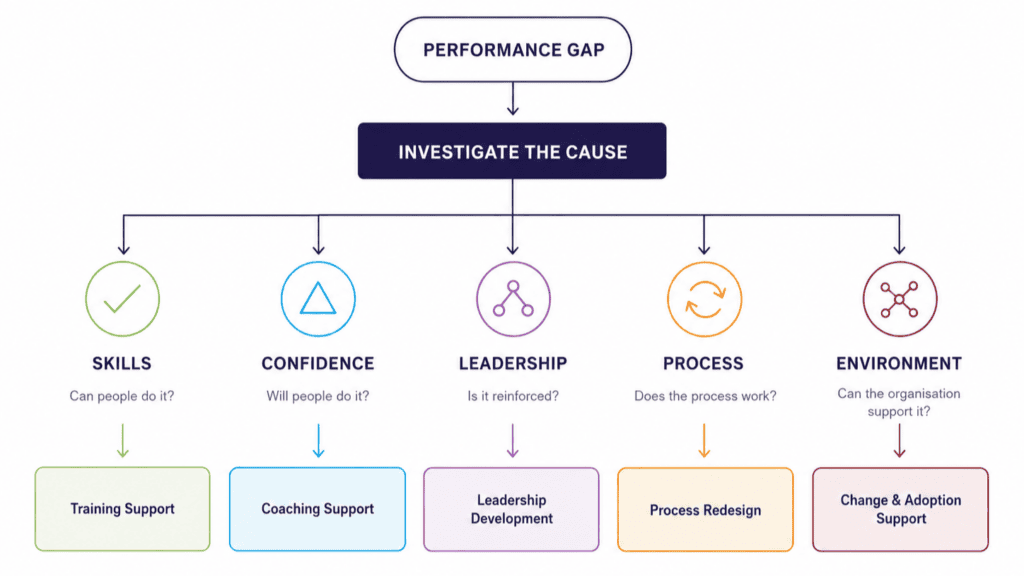
For example, employees may complete the required training and demonstrate that they can use an AI tool, yet avoid it during daily work. The root cause may involve low confidence, uncertainty about acceptable use, or concerns about output accuracy. As described in our article on why learning is the real enabler of AI adoption, organizations often find that continuous learning and capability development place greater constraints on adoption than the technology.
5. Build Targeted Interventions
Begin intervention design after the root cause is clear, and treat training as one of several possible responses. Findings from step four may point to coaching, leadership development, workflow redesign, change support, training, or a coordinated mix of approaches. Assign an owner, delivery schedule, success measure, and review date to each recommendation. This sequence directs investment toward the specific conditions restricting performance.
Converting learning needs into focused capability support
500+
employees reached
1,300+
unique learning hub interactions
10,000+
views, with a 90% return rate
Client need: A life sciences client had to prepare more than 500 employees for a new product area, broader role expectations, and a future operating model supporting patient safety and regulatory reporting. Audience groups differed in baseline knowledge, content relevance, and learning preferences. A single traditional course would have produced limited engagement.
Afiniti’s approach: Afiniti analyzed impacted personas, current knowledge, and communication preferences, then developed a blended learning strategy. Short-form content, role-specific messages, and a centralized learning hub gave employees access to relevant material at the right point in the rollout and in formats suited to their responsibilities and experience.
Business impact: The learning experience generated more than 1,300 unique interactions and 10,000 views; 90% of users returned. Reusable assets supported the extended rollout and built interest across the program. The results demonstrate how targeted learning design can convert capability needs into measurable employee engagement.
“I am grateful for the creative way Afiniti made our work shine through the sea of projects that are all vying for attention and share of mind.”
Principal Safety Director & Business Lead
Training Needs Assessment Template
A practical training needs assessment template should document the evidence, analysis, and resulting decisions in one place. Organize it around the five-step process above and include these core fields:
- Target business outcome and connection to strategy
- Current-state evidence organized by source
- Required future-state performance
- Specific, measurable capability gap statement
- Root-cause category: skills, process, leadership, adoption, or tools
- Recommended intervention with supporting rationale
- Success measure and scheduled review date
A shared template promotes consistency across departments by applying the same evidence standards and decision criteria to every assessment.
Training Needs Assessment Template
Building Capability for Sustainable Performance
Knowledge transfer is one input to capability building. Sustainable capability also requires employees to apply their learning under real operating conditions. Organizations that stop at information delivery frequently see little lasting movement in performance.
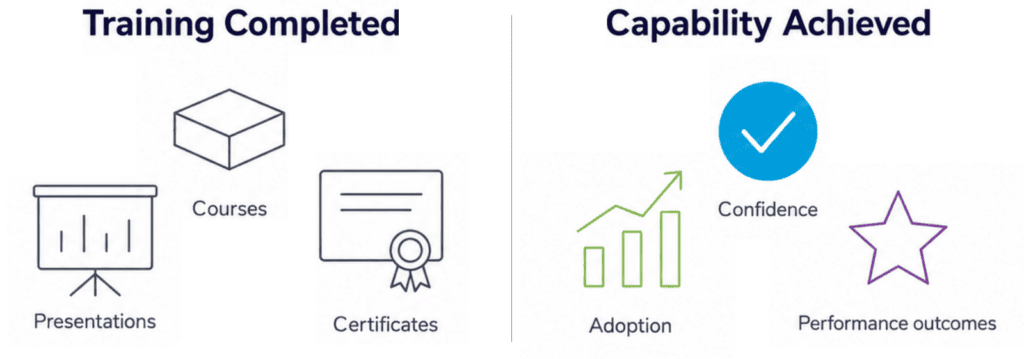
Confidence, behavior change, and reinforcement turn a completed course into workplace capability. Performance improves when employees can apply new knowledge on the job, feel equipped to use it, and receive consistent encouragement from managers.
Organizations working to close capability gaps, especially during AI adoption and digital transformation, are increasingly investing in structured programs linked to business outcomes and supported over time.
Build capability beyond traditional training
Our Change 101 Bootcamp helps leaders build the skills, confidence and behaviors needed to support successful change and adoption.
How to Measure Training Needs Assessment Success
Course completions and attendance provide activity data; they do not establish whether the training needs assessment led to stronger performance. Success measures should connect directly to the business outcome defined in step one. Capture a baseline before intervention, then schedule follow-up measurement far enough after implementation to observe application on the job. Capability gaps carry measurable operating consequences. The UK Employer Skills Survey 2024 found that 65% of employers experiencing skills gaps reported an impact on business performance, including heavier workloads, increased operating costs, and difficulty meeting quality standards. Although the survey reflects UK employers, the underlying performance risks are relevant to US organizations.
Useful indicators of success include:
- Adoption rates for new tools, systems, and workflows
- Observed behavior change in the work activity under review
- Improvement in the performance measure targeted by the intervention
- Productivity gains within the relevant team or business function
- Employee confidence levels supported by manager observations
- Leadership effectiveness in reinforcing the desired behavior over time
Training Needs Assessment and Change Management ROI
A training needs assessment has a direct connection to change management ROI. Returns from a transformation program depend on adoption and sustained behavior change. By isolating root causes and matching each one to an appropriate intervention, a TNA protects the business case and directs funding to the gap restricting performance. Executives assessing change management ROI should include TNA findings and post-intervention results in the calculation from the beginning.
Common Training Needs Assessment Mistakes
Organizations often reduce the value of a training needs assessment through a small set of recurring mistakes:
- Selecting a course before completing the performance diagnosis
- Conducting the assessment without a defined business outcome
- Concentrating on technical proficiency while overlooking process, leadership, and confidence
- Leaving change readiness out of the capability review
- Ending measurement when the intervention concludes, allowing the gap to return
These mistakes frequently reinforce one another. When an assessment lacks a defined outcome, technical training can become the easiest recommendation. Measuring impact then becomes difficult because the organization never established a performance target.
For a practical starting point, select one priority business outcome and work backward. Define the performance gap, collect evidence from at least three sources, and classify the barrier as skill, confidence, process, leadership, or environment before designing a training activity.
Building Capability That Improves Performance
A well-executed training needs assessment shows organizations where performance is constrained and what support employees need as work continues to evolve. AI adoption is making capability assessment a continuous discipline. Rapid changes in tools and workflows create learning needs that are harder to predict and less likely to fit within a single project cycle.
Organizations that maintain training needs assessment as an ongoing business practice can keep workforce capability aligned with shifting strategic priorities.
Where to start
If you’re not sure whether the challenge is capability, confidence, leadership support or change readiness, our free online change readiness assessment helps identify the factors most likely to affect adoption and performance before you invest in solutions.
Training Needs Assessment FAQs
A training needs assessment is a structured process for identifying the gap between an organization’s current performance and the performance it needs to achieve its goals and for recommending the right intervention to close that gap.
The three levels are organizational, which looks at strategic capability against business goals; team or operational, which looks at process effectiveness and functional capability; and individual, which looks at knowledge, skills, confidence and behavioral barriers.
A skills gap analysis focuses specifically on missing knowledge or skills. A training needs assessment is broader, considering performance data, working conditions, leadership and change readiness and recommends solutions rather than only confirming a gap.
Ideally before a performance problem becomes visible and specifically ahead of digital transformation, ERP implementation, AI adoption, organizational restructuring, new leadership appointments or the introduction of new performance metrics.
By gathering performance evidence from multiple sources, surveys, interviews, workshops, metrics and observation, then comparing current state against the future state required by a defined business outcome and testing the root cause of any gap found.
No. Many performance gaps are caused by unclear processes, low confidence, weak leadership reinforcement, inadequate tools, or resistance to change. Training should be one option considered after root cause analysis, not the automatic first response.
A training needs assessment focuses on identifying performance gaps and deciding whether training is the right response. A learning needs assessment is closely related, but often looks more broadly at what people need to learn or develop, which may include training, coaching, mentoring, self-directed learning or on-the-job practice. The terms are sometimes used interchangeably, so the most important point is to link any identified need to business outcomes and test whether training is the right solution before designing an intervention.
