


Target Operating Model: Your Guide to Success
When you’re driving major business transformation, the Target Operating Model becomes your most powerful strategic tool. It’s the comprehensive blueprint that transforms your vision into executable reality, connecting your people, processes, and technology in ways that deliver measurable results.
Think of your Target Operating Model as your organization’s GPS for transformation. While your current operating model shows where you are today, your TOM charts the exact route to where you need to be tomorrow. Without this roadmap, transformation efforts scatter across disconnected initiatives, burning through budgets while missing strategic targets.
After guiding countless organizations through complex transformations, we’ve seen one consistent pattern: leaders who build robust Target Operating Models before launching change initiatives achieve dramatically better results than those who jump straight into execution mode.
Here’s what we’ll cover in this comprehensive guide:
- Core Target Operating Model concepts and definitions
- Essential TOM components that drive success
- Real-world applications and transformation scenarios
- Strategic advantages of TOM-driven change
- Common implementation mistakes and how to avoid them
- Step-by-step planning, design, and execution frameworks
- A detailed case study showing TOM transformation in action
Are you ready for TOM transformation?
Implementing a new TOM brings major transformation, so make sure your people are receptive to change with our free 5-minute readiness assessment tool.
Target Operating Model definitions
Your Target Operating Model serves as the strategic blueprint defining how your organization will function to achieve specific business objectives. It’s the architectural foundation for transformation, where your business strategy sets the destination, your TOM builds the bridge to get there.
Many executives struggle with related concepts, so let’s establish clear distinctions:
Business model vs. operating model: value creation vs. value Delivery
Your business model addresses fundamental value questions: what you deliver, to whom, and how you monetize those relationships. It defines your economic engine. Your operating model focuses on execution: how, where, and when that value gets created and delivered to customers.
Consider a cloud software company. Their business model centers on recurring subscription revenue from digital platforms. Their operating model determines whether they use agile development methodologies, how customer success teams are structured, where servers are located, and how new users get onboarded. The business model defines market positioning; the operating model creates operational excellence.
Target Operating Model vs. business strategy: destination vs. journey
This distinction proves critical for transformation success. Your business strategy defines your destination; new markets, competitive advantages, or growth targets. Your Target Operating Model defines the specific journey; how your organization, people, processes, and systems will deliver those strategic outcomes.
Strategy without an operating model stays theoretical. An operating model without strategic alignment becomes operational chaos. You need both working in perfect synchronization.

Core Target Operating Model components
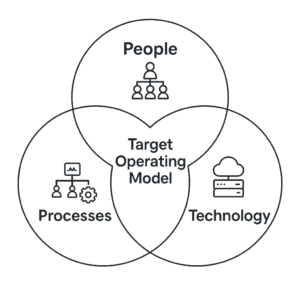
Every high-performing TOM builds on three fundamental pillars, though the specific design varies based on your organization’s strategic context and transformation objectives.
People: your human operating system
The people component encompasses organizational design, roles, accountability structures, and culture. This goes far beyond organization charts; it’s about decision-making flows, information sharing, and cultural behaviors that either accelerate or constrain performance.
When designing this element, consider management spans, decision authority, skill gaps, and cultural shifts needed for your future state. The most sophisticated technology and streamlined processes fail without people who are equipped and motivated to execute effectively.
Processes: your operational backbone
Processes define how work flows through your organization. This includes operational workflows, procedures, and decision frameworks that connect your people with your technology to create customer value.
Effective process design balances operational efficiency with market responsiveness. You want streamlined operations that can pivot when competitive conditions shift or when you discover better approaches to value creation.
Technology: your digital infrastructure
Technology includes platforms, tools, and IT infrastructure supporting your operations. Here’s what many leaders miss: technology should enable your operating model, not control it. Too often, organizations design their operating model around existing technology limitations rather than defining requirements first.
The POLISM framework: complete operational coverage
For deeper analysis, POLISM (Process, Organization, Location, Information, Suppliers, Management systems) provides comprehensive coverage for evaluating and designing Target Operating Models.
This framework ensures you address all operational dimensions rather than focusing only on obvious elements. Location strategies, supplier relationships, and information flows often prove more critical to transformation success than initially apparent.
Target Operating Model applications
Target Operating Models deliver value across multiple transformation scenarios, but here are four critical use cases that executives frequently encounter.
Mergers & acquisitions
M&A represents the most complex TOM challenge. You’re creating a unified operating model that integrates people, processes, and systems from multiple organizations while maintaining business continuity. Complexity multiplies when organizations have different cultures, technologies, and operational approaches, making a clear integration blueprint absolutely essential.
Digital transformation
Digital transformation initiatives demand fundamental shifts from manual to automated or AI-enhanced systems. Your current operating model, optimized for human-centric processes, rarely translates directly to digital-first operations. You need intentional redesign.
Cost optimization
Cost reduction programs benefit enormously from TOM thinking. Rather than across-the-board cuts, you can identify specific operational inefficiencies and redesign processes for optimal cost-effectiveness while maintaining service quality.
Business model evolution
Moving from product-based to service-based models, for example, demands comprehensive operating model redesign. Your current structure, optimized for manufacturing and distribution, won’t naturally support service delivery and customer relationship management.
Real-world excellence: Maersk’s end-to-end logistics evolution
Maersk’s transformation from traditional shipping company to integrated logistics platform shows you exactly what Target Operating Model redesign can accomplish. Instead of just digitizing what already existed, this Danish powerhouse completely reimagined how global supply chains deliver value.
Here’s what made the difference: Maersk tore down century-old silos that separated shipping, port operations, and logistics services. They rebuilt around customer experiences, not internal asset categories. Their technology evolved from tracking individual ships to orchestrating complete supply chain networks. Success metrics shifted from measuring vessel efficiency to guaranteeing end-to-end delivery performance.
This transformation touched every operational aspect, from how they recruit talent to how they measure wins. That’s the power of a comprehensive Target Operating Model approach.
Target Operating Model Case Study: Transforming Healthcare Workforce Solutions

The COVID-19 pandemic created explosive demand that overwhelmed the UK’s leading NHS flexible staff bank. Their legacy operating system couldn’t effectively serve over 50 NHS Trusts and 180,000 bank members. The organization needed aggressive strategic transformation to become the preferred workforce partner for healthcare and social care sectors. This required more than technology upgrades and process improvements. It demanded fundamental cultural and operational shifts.
Through strategic partnership, we developed a future-focused Target Operating Model built on organizational purpose, operational clarity, and people-centered design. Via intensive TOM workshops, we restructured their operational framework across personnel, processes, technology, and data systems. We also embedded sustainable change capabilities, established business process governance, and equipped internal teams with tools and skills for leading their own transformation.
With ADKAR methodology deployed across major programs and change champions activated organization-wide, the client now progresses toward becoming a strategic, resilient leader in UK healthcare workforce solutions, placing more healthcare professionals in more locations to accelerate care delivery. See the full story here.
Importance of Target Operating Models
Target Operating Models transform confusion into clarity. When your entire organization knows exactly how the future will work, decision-making gets faster and strategic alignment becomes automatic. And that strategic alignment can make up to 80% of the difference between two organizations’ performance.
This clarity delivers immediate operational gains: streamlined efficiency, rock-solid governance, and built-in scalability. Your operations stop reacting to every market shift and start driving intentional outcomes.
Transformation results: the TOM advantage
The performance gap between organizations with and without Target Operating Models tells the whole story:
| With a Target Operating Model | Without a Target Operating Model |
| Strategic focus ensures every change initiative creates real business value, not just completed projects | Change efforts burn budgets without delivering expected returns because they lack strategic direction |
| Built-in agility lets you pivot fast when markets shift or competitive threats emerge | Organizational change becomes rigid and can’t adapt when circumstances evolve |
| Operational gains multiply because you know exactly where to focus efforts for maximum impact | No clear prioritization framework means missing the biggest improvement opportunities |
| Employee engagement skyrockets when people understand their role in the organization’s future | Resistance to change increases due to uncertainty and unclear direction |
| Customer outcomes improve through consistent, intentionally designed service experiences | Customer experience suffers from inconsistent or confusing service delivery |
Organizations that build solid Target Operating Models consistently hit their transformation targets faster and more completely than those flying blind.
Frequent Target Operating Model mistakes
The over-engineering spiral
Here’s where smart leaders crash and burn: they build Target Operating Models so complex they become impossible to execute. These elaborate frameworks look impressive in PowerPoint but create bureaucratic nightmares that paralyze teams.
Your TOM needs to guide decisions and drive action, not drown people in process documentation. The best models balance detailed guidance with practical flexibility; they’re comprehensive enough to prevent confusion but agile enough to adapt when reality hits.
The ivory tower trap
Another transformation killer: designing your TOM without input from the people who’ll actually make it work. Your frontline teams, middle managers, and key players have insights about operational reality that executive teams often completely miss.
Smart stakeholder engagement doesn’t just build buy-in, it builds a better operating model. One that recognizes real constraints and opportunities instead of theoretical perfection.
Culture: the silent TOM killer
Organizational culture will make or break your Target Operating Model, yet most leaders treat it as an afterthought. Cultural resistance kills more transformations than budget constraints or technical challenges.
Your TOM must work with your cultural strengths and directly address cultural barriers that could derail implementation. This means brutally honest assessment of how things really work today and smart strategies for cultural evolution.
The one-size-fits-all myth
The most dangerous mistake? Treating Target Operating Models like universal solutions you can copy from other companies or roll out uniformly across different business units.
Every organization has unique strategic goals, competitive realities, and operational constraints. Your TOM needs to reflect these specifics, not follow generic playbooks. Watch out for advisors who claim their approach works for everyone!
“Organizations that build solid Target Operating Models consistently hit their transformation targets faster and more completely than those flying blind.“
Planning your Target Operating Model
Build your TOM planning on these four foundation steps:
- Lock in strategic alignment
- Get leadership fully committed
- Map your current reality
- Chart the path to your future state
Lock in strategic alignment
Your Target Operating Model must connect directly to your business strategy – no exceptions. Every operational decision needs to drive your strategic goals forward, not work against them. Think of it this way: your strategy sets the destination, your TOM builds the highway to get there. Starting construction without knowing where you’re headed guarantees you’ll end up nowhere useful.
Strategic alignment means you clearly understand your strategy’s core priorities, competitive advantages, and success benchmarks. Your TOM becomes the engine that powers these strategic elements into reality.
Get leadership fully committed
Executive buy-in makes or breaks your TOM. Half-hearted leadership support kills transformation faster than any external challenge. Without real commitment from your C-suite, you’ll hit resource roadblocks, competing priorities, and organizational pushback that can destroy even brilliant operating models.
Real leadership commitment goes way beyond signing off on budgets. You need active championship, dedicated resources, and consistent messaging that reinforces transformation priorities across your entire organization.
Map your current reality
You can’t design an effective future state without understanding exactly where you stand right now. Smart current state analysis uses battle-tested frameworks:
- SWOT Analysis: Shows you which organizational strengths to leverage, which weaknesses to fix, which opportunities to grab, and which threats to counter. This analysis tells you what capabilities to keep and what gaps your Target Operating Model needs to fill.
- PESTLE Analysis: Reveals how Political, Economic, Social, Technological, Legal, and Environmental forces could impact your operating model’s performance. These outside factors often drive operational design choices more than internal considerations.
- Direct Stakeholder Input: Your people hold the most valuable insights. Get direct input on needs, frustrations, and wins from teams across your organization. This ground-truth data gives you practical insights that analytical frameworks miss.
Chart your path forward
Run comprehensive gap analysis to pinpoint exactly what needs to change between where you are and where you’re going. This analysis becomes your prioritization and sequencing roadmap.
Use this intelligence to scope your TOM transformation with clear boundaries, realistic timelines, and the right team structure for execution. Balance your transformation ambitions with keeping operations running smoothly.
Designing your Target Operating Model
Your TOM design needs to address these strategic areas:
- North Star vision that drives everything
- Department-specific goals that align with your vision
- Governance that speeds decisions instead of slowing them down
- Risk mitigation that protects your transformation
- Built-in agility that lets you pivot when needed
- Smart prioritization that delivers early wins
- Success metrics that prove your impact
Your North Star vision
Every transformation needs a crystal-clear vision that defines your future state and guides every operational choice. This North Star keeps your teams focused and aligned across all transformation phases.
The best vision statements combine inspiration with specifics. They energize your organization while providing concrete direction for operational decisions.
Department-specific goals
Break your vision down into specific goals for each operational area. These goals must connect directly to your North Star while addressing each function’s unique requirements:
- Customer Experience: Cut response times and boost resolution rates
- Operations: Streamline workflows and slash operational costs
- Technology: Modernize systems and improve reliability
- Human Resources: Build new capabilities and speed up decisions
- Finance: Increase reporting accuracy and accelerate financial processes
- Supply Chain: Boost visibility and optimize inventory levels
Smart governance
Governance structures determine transformation success. You need decision-making frameworks that enable fast coordination without creating bureaucratic bottlenecks.
Risk mitigation
Every Target Operating Model faces implementation risks that could kill your transformation. Identify these threats early and build specific safeguards into your operating model design.
Built-in agility
Make sure your TOM can adapt fast when circumstances change. Rigid operating models fail when markets shift or implementation reveals unexpected challenges.
Strategic prioritization
Phase your implementation to unlock maximum business value first. This approach lets you demonstrate quick wins while building capabilities for more complex transformation elements. Smart sequencing reduces risk while maintaining momentum.
Success metrics that matter
Define specific KPIs that track progress and measure real impact. These metrics need to show both operational efficiency gains and strategic objective achievement.
Executing your Target Operating Model
Your TOM delivers zero value until you execute it flawlessly. Here’s how to make it happen:
- Build a bulletproof roadmap
- Put your people first, always
- Communicate with impact
- Deploy change champions everywhere
- Train for the skills that matter
Build your bulletproof roadmap
Transform your TOM design into a time-based action plan with clear milestones and ironclad accountability. Balance transformation speed with your organization’s capacity for change. When you map the journey transparently, people buy in and resistance drops.
Smart roadmaps include dependencies, resource needs, and backup plans for when challenges hit. They break down into concrete phases that build momentum and create opportunities to celebrate wins along the way.
Put people first, always
TOM execution wins or loses on the human side. Technology and process get most of the attention, but transformation fails when people aren’t equipped and motivated to execute new ways of working. Make your people the priority throughout, even when your transformation takes years.
Communicate for maximum impact
Your communication strategy needs transparent, frequent updates on progress, challenges, and victories. Consistent communication builds confidence and keeps engagement high when transformation gets tough. Make your communications creative and engaging so they cut through the noise from other initiatives. Connect everything back to your North Star vision to tell your transformation story and build emotional investment.
Deploy change champions everywhere
Champions and sponsors throughout your organization model new behaviors and influence peer adoption. These influencers often drive cultural shifts more effectively than formal change management programs, so engage them early and get their input at every stage.
Train for skills that actually matter
Training and development initiatives must equip your people with the exact skills and knowledge your future operating model requires. This includes technical capabilities and soft skills for working in new organizational structures. No matter how excited people are about transformation, they can’t adopt and sustain changes they don’t know how to execute.
Target Operating Model Evolution Never Stops
Target Operating Models take years to implement fully, which means they must remain flexible and responsive throughout the entire transformation process. Your TOM needs to adapt to internal organizational changes and external market pressures that will continuously reshape your journey.
You can’t treat your Target Operating Model as a completed project with a final deliverable. Instead, think of it as a living framework that grows stronger through:
- Strategic performance measurement
- Continuous stakeholder feedback and learning
- Market-driven adaptation
- Ongoing value confirmation
Strategic Performance Measurement
Your Target Operating Model requires measurement approaches that go well beyond traditional operational dashboards. The real challenge lies in selecting indicators that demonstrate actual TOM effectiveness rather than just measuring activity levels.
We’ve seen organizations track extensive KPI portfolios while completely missing fundamental changes in their competitive position or customer satisfaction. The most valuable performance metrics come from understanding your transformed operating model’s unique value creation drivers.
Build assessment rhythms that combine thorough analysis with actionable intelligence. These reviews should monitor performance trends, identify emerging patterns, and surface early warning indicators about potential operational challenges.
Continuous Stakeholder Feedback and Learning
Input from your users, teams, and stakeholders provides qualitative intelligence that numbers alone cannot deliver. Front-line staff often spot operational bottlenecks, process improvements, and customer insights that remain invisible on executive dashboards.
Design feedback systems that encourage authentic input rather than sanitized responses. Anonymous surveys, cross-functional retrospectives, and structured listening sessions can reveal operational truths that differ significantly from formal performance reports. The key is building psychological safety where people share honest observations about what’s working and what isn’t.
Just as important: establish clear processes for converting feedback into operational improvements that demonstrate genuine organizational responsiveness and continuous learning.
Market-Driven Adaptation
Market conditions, competitive dynamics, and internal capabilities change constantly, requiring corresponding Target Operating Model adjustments to maintain effectiveness.
Develop environmental scanning capabilities that detect relevant shifts in technology, regulation, customer behavior, and competitive landscape. Use these insights to drive regular TOM evaluation processes that assess whether your current operational design still delivers optimal results for your strategic objectives.
External changes sometimes create opportunities for operational enhancement. Other times they require defensive adjustments to protect competitive positioning. Your Target Operating Model must handle both scenarios effectively.
Ongoing Value Confirmation
Transformation success requires continuous validation that your Target Operating Model keeps delivering expected business value. This assessment should examine both quantitative performance improvements and qualitative changes in organizational capabilities, market position, and competitive responsiveness.
Document and communicate transformation achievements to maintain organizational commitment and identify opportunities for further enhancement. Success stories build confidence for additional change initiatives while revealing principles and practices that apply to future operational improvements.
Future Target Operating Model Trends
AI Integration Transforms Operations
Artificial intelligence and automation technologies enable operational excellence levels that weren’t previously achievable. AI integration affects individual processes and entire operational approaches to customer engagement, decision support, and workflow coordination.
Progressive organizations design Target Operating Models that assume comprehensive AI adoption rather than treating artificial intelligence as an addition to existing processes.
Distributed Operations Drive Flexibility
Remote and hybrid work models promote increasingly distributed and flexible operating model designs. Traditional hierarchical structures evolve toward flatter, network-based organizational forms that accelerate decision-making and expand employee autonomy.
This evolution requires rethinking established assumptions about management oversight, coordination mechanisms, and performance measurement approaches.
Sustainability Integration
Environmental and social objectives are no longer siloed under corporate social responsibility, with leaders claiming sustainability directly improves business performance. Instead, they’re becoming core to how operating models are designed and measured. Forward-looking organizations are embedding sustainability metrics directly into operational workflows and governance structures.
This shift is influencing supplier engagement strategies, site selection, technology adoption, and enterprise performance metrics across the entire value chain.
Advancing with Your Target Operating Model
A well-crafted Target Operating Model is one of the most effective levers for driving enterprise-level transformation. When built with intention and implemented with discipline, it becomes the practical playbook for turning strategic goals into operational results, without compromising execution quality.
Our experience shows that transformation success hinges less on complex theory and more on consistent execution of TOM fundamentals. That means aligning tightly with your business strategy, listening closely to your stakeholders, and staying grounded in what works, not just what looks good on paper.
The ability to operationalize vision into scalable, sustainable ways of working is what separates high-performing organizations from those stuck in cycles of disconnected change. Your Target Operating Model should make that shift tangible, anchoring your teams in clarity and driving outcomes that matter.
Ready to start building your Target Operating Model?
Start your transformation journey with the right strategy for success.
Target Operating Model FAQs
A target operating model (TOM) is a strategic framework that outlines how a company will function in the future to meet its goals. It defines how teams, processes, and technologies work together to turn strategy into day-to-day execution, serving as a bridge between vision and delivery.
To develop a target operating model, start by aligning it with your business strategy. Assess your current operating environment, identify capability gaps, and design a future-state structure across people, workflows, systems, and governance. Build a clear roadmap, involve key stakeholders, and track performance over time to refine and improve.
A target operating model should be specific enough to guide operational decisions and implementation, but not so detailed that it becomes rigid or hard to scale. It should clearly define accountabilities, core processes, supporting technologies, oversight mechanisms, and success metrics, while leaving space for iteration and growth.
An agile target operating model embeds agile principles into an organization’s structure and ways of working. It emphasizes cross-functional teams, short feedback loops, decentralized decision-making, and rapid responsiveness to change, helping companies remain flexible while delivering value consistently.
A target operating model roadmap is a step-by-step plan for how a business will shift from its current operating model to the target state. It includes timelines, implementation phases, interdependencies, and change management actions to ensure smooth, coordinated execution
Organizations often face challenges such as misalignment with strategy, resistance from employees, overengineered models, and cultural barriers. Without strong leadership and input from across the business, a TOM can become disconnected from reality and fail to gain traction.
A business model explains what a company offers and how it generates revenue. In contrast, an operating model describes how the business runs – its internal structure, processes, systems, and people – so it can deliver that value efficiently and consistently.
An operating model shows how a business functions today. A target operating model (TOM) represents a future vision of how the company will operate to meet new strategic goals. It’s a forward-looking design that enables transformation and growth.
A business strategy outlines what a company wants to achieve; its direction and competitive goals. A target operating model details how the organization will operationalize that strategy, covering structures, processes, people, and technology needed to get there.
A well-designed target operating model provides structure and clarity for transforming your business. It ensures your strategy is actionable by defining how your teams and systems should function in the future. Without it, transformation efforts risk fragmentation, inefficiency, and missed outcomes.
The time required to implement a TOM varies widely, from several months to multiple years, depending on your organization’s size, complexity, and transformation scope. A staged rollout with measurable wins helps maintain momentum and reduce disruption.
TOM design is typically led by senior executives, strategy leads, and functional heads, supported by transformation teams and input from across the business. While leadership sets the direction, collaborative input ensures the model reflects real operational needs and earns buy-in.
Yes, your target operating model should be a living framework. As market conditions, technologies, and business goals shift, your TOM should be reviewed and adjusted to stay relevant. Continuous feedback and improvement are key to long-term effectiveness.
Popular frameworks include POLISM (Process, Organization, Location, Information, Suppliers, Management systems), business capability models, and governance structures. These tools help ensure the TOM covers all critical areas of business operations holistically.
A target operating model enables digital transformation by aligning operations with new digital capabilities. It redefines how work gets done, integrates automation and data-driven decision-making, and ensures systems, teams, and workflows are optimized for a digital-first approach.
