


Stakeholder Mapping Explained: Tools, Stakeholder Maps, and Examples
Change initiatives are shaped by people as much as by plans or technology. Employees, leaders, customers, suppliers, partners, and regulators all influence how change is received and whether it delivers results. When their interests and concerns are not understood or addressed, initiatives often experience delays, reduced adoption, or outright failure.
Stakeholder mapping tools help organizations make sense of this complexity. A stakeholder map provides a structured way to visualize the people landscape surrounding a change initiative, highlighting who matters, how they influence outcomes, and where engagement effort should be focused. Rather than relying on assumptions or hierarchy alone, teams gain a clearer view of stakeholder dynamics.
Effective stakeholder mapping supports better decision-making throughout delivery. It helps teams prioritize engagement, tailor communication, and identify potential risks early. The value lies in how the map informs action, not in the artifact itself.
What Is Stakeholder Mapping?
Stakeholder mapping is a systematic approach to identifying and analyzing everyone who influences or is affected by your change initiative. It Stakeholder mapping is a structured approach to identifying and analyzing the individuals and groups who influence, or are affected by, a change initiative. The output is typically a visual representation, often called a stakeholder map, that organizes stakeholders according to defined criteria such as influence and interest.
Stakeholders include anyone whose work, outcomes, or responsibilities are impacted by the change, as well as those who can shape its success. This may include frontline employees, managers, executive sponsors, customers, external vendors, partners, or regulatory bodies. Each group experiences the change differently and brings distinct priorities and expectations.
The scale of stakeholder mapping varies depending on the scope of the initiative. A small process change may involve a limited number of stakeholders. An enterprise-wide transformation can involve large populations across functions, locations, and organizations. In both cases, the purpose of stakeholders mapping remains consistent: to create clarity about who needs to be engaged and why.
A stakeholder map helps answer practical questions that influence delivery. It identifies who needs to support the change, who can accelerate or delay progress, and who must be engaged for implementation to succeed. These insights shape engagement decisions and directly affect outcomes.
Why Stakeholder Mapping Matters
Stakeholder mapping tools are essential because they align engagement effort with influence and impact. Treating all stakeholders the same leads to wasted effort, while overlooking key stakeholders increases risk – which is why 78% of projects with high stakeholder engagement succeed, compared with only 40% success for low-engagement projects.
By mapping stakeholders, teams gain visibility into who holds influence, who is most affected by the change, and how stakeholders influence one another. This understanding informs engagement planning by highlighting where deeper involvement is required and where lighter communication is sufficient.
Stakeholder maps also help expose imbalance. Engagement often concentrates on senior leaders because they are visible and accessible, while those responsible for day-to-day adoption receive less attention. This disconnect creates gaps between decision-making and execution.
For example, in a technology upgrade aimed at improving customer service, frontline employees have high interest because their daily work changes. Senior leaders have high influence because they control budgets and priorities. Managers sit between these groups and shape how the change is implemented locally. Without stakeholder mapping, engagement may focus on leadership updates while underinvesting in manager and employee enablement. When the system goes live, adoption suffers and performance declines.
A stakeholder map helps prevent this by ensuring engagement is proportionate across all groups that influence success, not only those at the top of the organization.
When to Create Your Stakeholder Map
Create stakeholder maps at the start of the project once objectives are defined. Early stakeholder mapping gives you audience insight before you commit to specific engagement approaches, messages, or timelines. It helps you plan communications and involvement with a clearer view of who needs what, and when.
Your stakeholder map should be reviewed regularly to stay accurate. People change roles, vendors join or exit, priorities shift, and new stakeholders can emerge as scope becomes clearer. A map created early in the year can be materially wrong within months if it isn’t maintained.
Stakeholder mapping should be done collaboratively with other members of the change team. Different roles see different parts of the stakeholder landscape, and individual perspectives come with blind spots. A project manager may focus on delivery stakeholders and miss regulatory stakeholders. A technical lead may focus on system users and underestimate operational managers. Collaboration helps the map become more complete and reduces bias in how stakeholders are assessed.
The Stakeholder Mapping Process
Step 1: Define What ‘Stakeholder’ Means for Your Change
A stakeholder is anyone who may be involved in, or impacted by, your change; that includes external parties such as customers, suppliers, or partners. The scope of your stakeholder mapping depends on the scope of the initiative.
A small process update affecting one team will result in a small stakeholder map. A major enterprise change can affect large populations across functions and locations, requiring more detailed stakeholder analysis.
Before you start listing names, define boundaries so the mapping effort remains focused. For a departmental workflow change, stakeholders might include the department, IT support, and the process owner’s leadership chain. For a customer-facing platform replacement, stakeholders likely span multiple internal departments, customers, technology vendors, compliance teams, and potentially regulators. Clear scope prevents the exercise from expanding indefinitely while still protecting against missing critical voices.
Step 2: Define How You’ll Group Your Stakeholders
Define stakeholder groupings so you can tailor engagement appropriately and identify stakeholders systematically. Grouping makes it easier to ensure coverage across the organization and to design communications for coherent audiences rather than hundreds of individuals.
Groupings may be based on role, function, capability, geography, customer segment, or supplier category. The best approach depends on your change. If you’re implementing compliance requirements, functional groupings often work well because legal, finance, and operations face different implications. If you’re rolling out regionally, geography may matter more because timing and support needs differ by location.
These groupings become the framework for your engagement plan. Instead of managing stakeholder relationships one by one, you design approaches for segments with shared needs and impacts.
Step 3: List and Begin Mapping Your Stakeholders
Once you’ve defined stakeholders and groupings, begin listing stakeholders. Start broad and refine later. Capture every person, team, or organization that touches the change, then consolidate duplicates or subgroups after you have a complete view.
Use your groupings as prompts to check coverage: have you included all affected functions, all customer types, and all vendor relationships? Treat the stakeholder map as a living document so stakeholders can be added as they are identified or as the initiative evolves.
With the list in place, you can map stakeholders by influence and interest, forming the basis for the stakeholder matrix tool you’ll use to determine engagement priorities.
How to Map Stakeholders: The Power-Interest Matrix
Once stakeholders are identified, they can be mapped based on how much influence they have over the change and how interested they are in its outcome. This step turns a stakeholder list into a practical tool for deciding how to engage different groups.
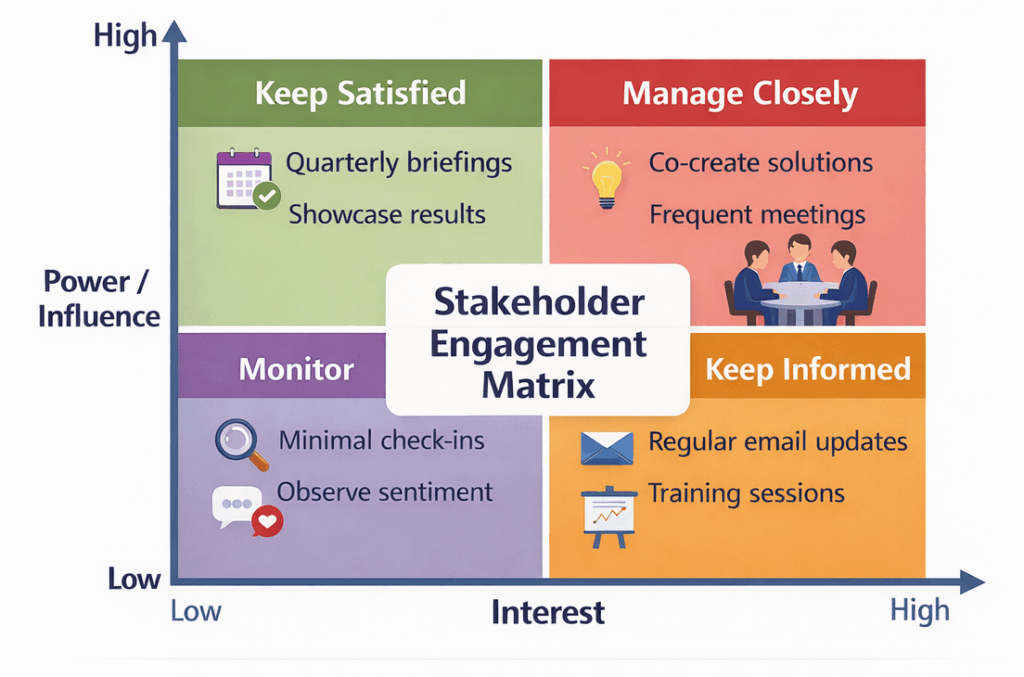
A stakeholder matrix tool is commonly used to visualize this information. The Mendelow power-interest matrix, developed by Aubrey L. Mendelow, is a widely adopted approach. Stakeholders are plotted on a four-quadrant grid, with influence or power on the vertical axis and interest on the horizontal axis. Higher levels of influence appear toward the top of the matrix, while higher levels of interest appear toward the right.
Each quadrant represents a different engagement approach, reflecting how much attention and involvement each stakeholder requires.
- High influence and high interest stakeholders sit in the manage closely quadrant.
- High influence and low interest stakeholders fall into keep satisfied.
- Low influence and high interest stakeholders are placed in keep informed.
- Low influence and low interest stakeholders sit in monitor.
This structure helps teams focus effort where it has the greatest impact while maintaining visibility across the broader stakeholder landscape.

Understanding Influence and Interest
How influence and interest are assessed determines where stakeholders sit on the matrix, so clarity and consistency are important.
Influence refers to a stakeholder’s ability to affect how the change is perceived, supported, or resisted. This influence may be formal, such as decision-making authority or budget ownership, or informal, such as credibility, experience, or network reach. Informal influence can be particularly powerful, as attitudes expressed by respected individuals often spread quickly.
Interest reflects how directly the change affects a stakeholder’s work, objectives, or experience. Stakeholders who must adopt new processes or systems typically have higher interest than those who receive summary information or indirect benefits.
Stakeholders can be assessed numerically or descriptively. Numeric scoring allows comparison across large groups, while descriptive assessment captures nuance that numbers may miss. Many teams combine both approaches by scoring stakeholders initially, then validating placements by reviewing whether the resulting quadrant aligns with practical experience.
The Four Engagement Strategies
Once stakeholders are mapped, engagement strategies become clearer.
Manage closely stakeholders have both high influence and high interest. These stakeholders require regular, two-way engagement. They should be involved in key decisions, consulted on impacts, and treated as partners in delivery. Their support sustains momentum, while disengagement can quickly create obstacles.
Monitor stakeholders have low influence and low interest. They require minimal engagement beyond awareness-level communication, but their position should be reviewed periodically in case circumstances change.
Keep satisfied stakeholders have high influence but lower interest. They may not want to be deeply involved, but their confidence in progress matters. Engagement should focus on high-level updates that demonstrate control, progress, and risk management.
Keep informed stakeholders have high interest but limited formal influence. Regular communication builds understanding and trust, helping prevent frustration from turning into resistance. When kept informed, these stakeholders often become advocates for the change within their teams.
Stakeholder Mapping Examples in Practice
Consider a retail organization implementing a new point-of-sale system across hundreds of locations. Store managers have high interest because the change affects daily operations, and moderate influence because they shape local adoption. Depending on their leadership reach, they may sit in keep informed or manage closely.
The chief operating officer has high influence through budget ownership and strategic oversight, but lower day-to-day interest. This role typically falls into keep satisfied, requiring concise updates rather than operational detail.
Frontline employees use the system constantly, giving them high interest but limited formal influence. They belong in keep informed, supported through regular updates, training, and feedback channels.
IT support teams have both high influence and high interest. They enable system stability and long-term performance, placing them firmly in manage closely. Technology vendors delivering the system also hold high influence and interest and require structured governance and regular collaboration.
Alternative Stakeholder Mapping Methods
While the power–interest matrix is one of the most widely used stakeholder mapping tools, it is not the only approach. Different stakeholder maps can offer additional insight depending on the nature of the change and the challenges involved.
Salience model
Evaluates stakeholders across three dimensions: power, legitimacy, and urgency. Stakeholders may possess one, two, or all three attributes. Those who score highly across all three are considered definitive stakeholders and require immediate attention. This model is particularly useful when multiple stakeholder groups are competing for attention and prioritization is difficult.
Stakeholder knowledge-based charts
Focus on what stakeholders know, what they need to know, and when they need that information. This approach is valuable when the primary risk to success lies in misunderstanding or information gaps, such as when technical or regulatory changes must be communicated to non-specialist audiences.
The power-predictability matrix
Plots stakeholders based on their influence and how predictably they are likely to respond to change. Highly influential but unpredictable stakeholders present heightened risk, as their reactions are difficult to anticipate. Mapping predictability helps teams identify where contingency planning and closer monitoring may be required.
The power-dynamism matrix
Maps stakeholder influence against how likely their position is to change over time. Stakeholders with high power and high dynamism can introduce volatility into a change initiative. Regular engagement and reassessment help track shifts before they create disruption.
Relationship mapping
Takes a different approach by focusing on how stakeholders are connected to one another rather than placing them on axes. It visualizes formal and informal relationships, revealing influence pathways that organizational charts often miss. This method is especially useful in complex organizations where informal networks strongly shape decision-making.

Moving from Map to Action
Completing a stakeholder map is only the starting point. To create value, the outputs must inform decisions and guide behavior across the change team.
Once mapping is complete, ensure all members of the change team understand and agree on the stakeholder map. Alignment is critical; inconsistent interpretations lead to inconsistent engagement. When mapping has been done collaboratively, this alignment is easier to achieve.
Stakeholder maps should be used alongside change impact assessments. Understanding who is affected and how much they are affected provides essential context for deciding engagement approaches. A stakeholder with high influence and high impact may require direct, frequent interaction to build trust and commitment. A stakeholder with low interest and low impact may only need periodic updates through standard channels.
Engagement strategies should remain flexible. As the initiative progresses, stakeholder influence and interest can shift. Regular review of the stakeholder map helps ensure engagement remains proportionate and relevant rather than based on outdated assumptions.
Ready for change?
Our 6LeverTM Change Readiness Assessment tool is reveals the strengths and gaps in your team’s ability to embrace change for free in under five minutes.
AI and Stakeholder Mapping
AI is increasingly being applied to stakeholder analysis, offering new ways to augment traditional stakeholder mapping tools. Machine learning models can analyze communication patterns, meeting data, and organizational networks to identify relationships and influence pathways that may not be immediately visible.
Natural language processing can be used to assess sentiment in internal communications, helping teams detect emerging resistance or declining confidence earlier than traditional feedback mechanisms. AI can also support initial mapping by suggesting influence levels based on organizational hierarchy, role, and involvement in the initiative.
AI can accelerate the mechanics of stakeholder mapping, but it does not remove the need for human judgment. Informal influence, cultural context, and subtle shifts in power are difficult to capture through data alone. Effective stakeholder mapping uses AI to enhance insight, not replace practitioner experience.
The Foundation of Successful Change
Stakeholder mapping sits at the heart of effective change delivery. Without it, teams operate with limited visibility into the human dynamics that determine success. Engagement becomes reactive, resources are misallocated, and resistance surfaces late, when it is harder to address.
Stakeholder maps provide clarity when complexity increases. They transform broad goals around engagement and buy-in into specific decisions about who needs attention, how often, and in what form. They help surface risk early and support more intentional communication and involvement.
Organizations that deliver successful change consistently are not those with the most ambitious strategies or the largest budgets. They are those that understand their stakeholders, engage them proportionately, and adapt as conditions evolve. Stakeholder mapping tools provide the structure to support that discipline and create change that lasts.
Ready to Map Your Stakeholders?
If you’re leading significant change and need both immediate clarity and durable internal capability, we partner with your teams to co-create stakeholder maps grounded in how your organization actually operates.
Stakeholder Mapping Tools FAQs
A stakeholder matrix includes all individuals, teams, or organizations that influence or are impacted by your change. Stakeholders are plotted based on their level of influence or power (Y-axis) and their level of interest (X-axis). Each stakeholder is positioned into one of four quadrants: manage closely, keep satisfied, keep informed, or monitor. The matrix should include stakeholder names or groups, their role in the change, the rationale for their scoring, and the engagement approach associated with their placement.
A stakeholder map contains a comprehensive view of everyone who affects or is affected by a change initiative. Stakeholders are organized using relevant groupings such as function, role, or geography and mapped according to their relative influence and interest. Most stakeholder maps use a power-interest matrix to visualize these dynamics and indicate the appropriate engagement approach for each stakeholder or group. The map also reflects relationships between stakeholders and evolves over time as roles, priorities, and positions shift.
The purpose of a stakeholder map is to support informed engagement decisions by clarifying who holds influence over a change, who is most invested in it, and where resistance or support may emerge. It turns general goals around stakeholder buy-in into specific, actionable engagement priorities. By differentiating stakeholders rather than treating them uniformly, the map helps teams allocate time and resources proportionately and address potential risks before they disrupt delivery.
Create a strong stakeholder map by first defining what “stakeholder” means for the specific change and deciding how stakeholders will be grouped. Identify stakeholders collaboratively with the change team to reduce blind spots. Assess each stakeholder’s influence and interest using numerical scores or qualitative judgment, then plot them on a power-interest matrix. Assign engagement strategies based on their position and revisit the map regularly as the initiative progresses and stakeholder dynamics change.
A good stakeholder map is thorough without being overly complex. It includes all stakeholders who materially affect the change and reflects input from multiple perspectives rather than a single point of view. Influence and interest assessments are applied consistently and supported by clear reasoning. Most importantly, the map informs action; it directly shapes engagement planning, highlights risk early, and is reviewed and updated to remain accurate as conditions evolve.
For most business changes, the Mendelow power-interest matrix is the most effective stakeholder mapping tool because it combines simplicity with strategic value. It plots stakeholders across four quadrants based on influence and interest, leading to clear engagement approaches. In more complex situations, models such as the salience model or relationship mapping can add value. AI-enabled tools increasingly support analysis through pattern detection and sentiment insights, though human judgment remains critical for interpreting informal influence and context.
Common mistakes include creating the stakeholder map in isolation rather than collaboratively, overlooking informal influencers who lack formal authority, and treating the map as a one-time activity. Teams also frequently fail to define what “stakeholder” means for their specific change, resulting in either overly broad lists or critical gaps. Another frequent issue is scoring stakeholders based only on hierarchy, ignoring that employees with high day-to-day impact can significantly influence outcomes. Maps that never inform engagement plans provide little practical value.
For most initiatives, stakeholder maps should be reviewed quarterly. Fast-moving or high-impact changes may require monthly review. The map should also be revisited when significant events occur, such as leadership changes, scope shifts, emerging resistance, or new stakeholder groups. Regular updates ensure the map reflects current conditions rather than becoming an outdated snapshot.
No. RACI is not a stakeholder matrix, although both are commonly used in change and project management. RACI clarifies who is Responsible, Accountable, Consulted, and Informed for specific tasks or decisions. A stakeholder matrix categorizes stakeholders based on influence and interest to guide engagement across the initiative. RACI focuses on execution and accountability; stakeholder matrices focus on engagement strategy. Used together, they provide complementary insight.
The terms are closely related but not identical. Stakeholder mapping refers to the overall process of identifying and analyzing stakeholders and the resulting documentation. The stakeholder matrix, usually the power-interest matrix, is one visualization method used within that process. In practice, the terms are often used interchangeably because the matrix is the most common way stakeholder maps are presented.
