


The Ultimate Change Management Toolkit Guide for Leaders
Organizational change introduces complexity, uncertainty, and risk. Whether you are reorganizing a business unit, implementing new technology, or shifting organizational culture, the distance between announcing change and making it stick is where many initiatives fall apart.
This guide explains how a change management toolkit helps close that gap; what a change management toolkit is; what it should include; how to build and use one effectively; and the results a well-designed toolkit can deliver, illustrated through a real-world case study.
What Is a Change Management Toolkit?
A change management toolkit is one of several practical foundations used within a broader business change management approach to help organizations move from strategy to sustained adoption. It is a structured yet adaptable set of resources, templates, and strategies designed to support organizational change, giving leaders and managers a consistent, evidence-based framework for planning, communicating, and embedding change, regardless of scale.
The toolkit is not a fixed methodology. It functions as a practical operating system for change, able to flex across organizational cultures, delivery approaches, and program timelines; whether you are working within an ADKAR or Kotter framework, running an agile delivery model, or navigating an approach specific to your enterprise.
When applied effectively, a change management toolkit ensures that everyone responsible for leading change is working from the same playbook, using shared language, aligned assets, and consistent measures of success.
Why Organizations Cannot Afford to Lead Change Without One
Without a change management toolkit, organizations repeatedly encounter the same challenges:
- Resistance from employees who lack understanding or trust in the change
- Inconsistent messaging across teams, functions, and regions
- Adoption that stalls once go-live pressure eases
- Escalating costs driven by rework and correction
- Declining engagement and lost productivity
These risks compound quickly. Disengaged employees become harder to re-engage. Managers without structured guidance improvise, creating fragmented experiences across their teams. Projects may formally close, yet the intended change never fully embeds, leaving expected benefits unrealized.
A well-designed change management toolkit for leaders addresses these risks directly. It creates the conditions for people to understand, accept, and adopt change. It builds manager capability and confidence during periods of transition. It also provides organizations with reusable assets and institutional knowledge that strengthen the return on future change investments.
The business case is well established: organizations that invest in structured change management are significantly more likely to meet objectives, stay on budget, and sustain outcomes beyond implementation.
Benefits of a Change Management Toolkit
Building and deploying a tailored change management toolkit enables organizations to:
- Increase efficiency by standardizing change-related work through ready-to-use assets and frameworks
- Establish enterprise-wide consistency in approach, language, and standards
- Reduce resistance by addressing stakeholder needs through structured communication and engagement
- Ensure change becomes embedded in daily operations rather than remaining a launch event
- Enable leaders and managers to deliver future initiatives with greater confidence and reduced external support
- Improve data quality and visibility across programs and workstreams
- Support sustainable improvement by creating reusable assets applicable across initiatives
- Drive cost savings by minimizing rework, failed adoption, and poorly managed transitions
Core Components of a Change Management Toolkit
There is no single definition of what a toolkit must contain; components should reflect the scale, complexity, and nature of the change. That said, effective change management toolkits for leaders share a core set of tools that support decision-making, engagement, and adoption across the full program lifecycle.

Business Case Template
A structured template that helps change leaders clearly articulate purpose, rationale, and expected benefits in a consistent and compelling way. This anchor document aligns sponsors, builds stakeholder credibility, and establishes the strategic context for the work ahead.
Change Readiness Assessment
A diagnostic that evaluates an organization’s preparedness to accept and adopt change, identifying risks, capability gaps, and cultural factors before execution is fully underway. Addressing readiness early is significantly more efficient than managing resistance later.
You can assess your organization’s change readiness in five minutes using our free online change readiness assessment tool.
Change Impact Assessment
A structured approach for analyzing how change affects roles, processes, people, and systems. Detailed impact mapping improves engagement prioritization, informs targeted support, and directs effort where it delivers the greatest value.
If you are new to this discipline, you may find it helpful to read our guide to change impact assessments.
Stakeholder Mapping and Analysis
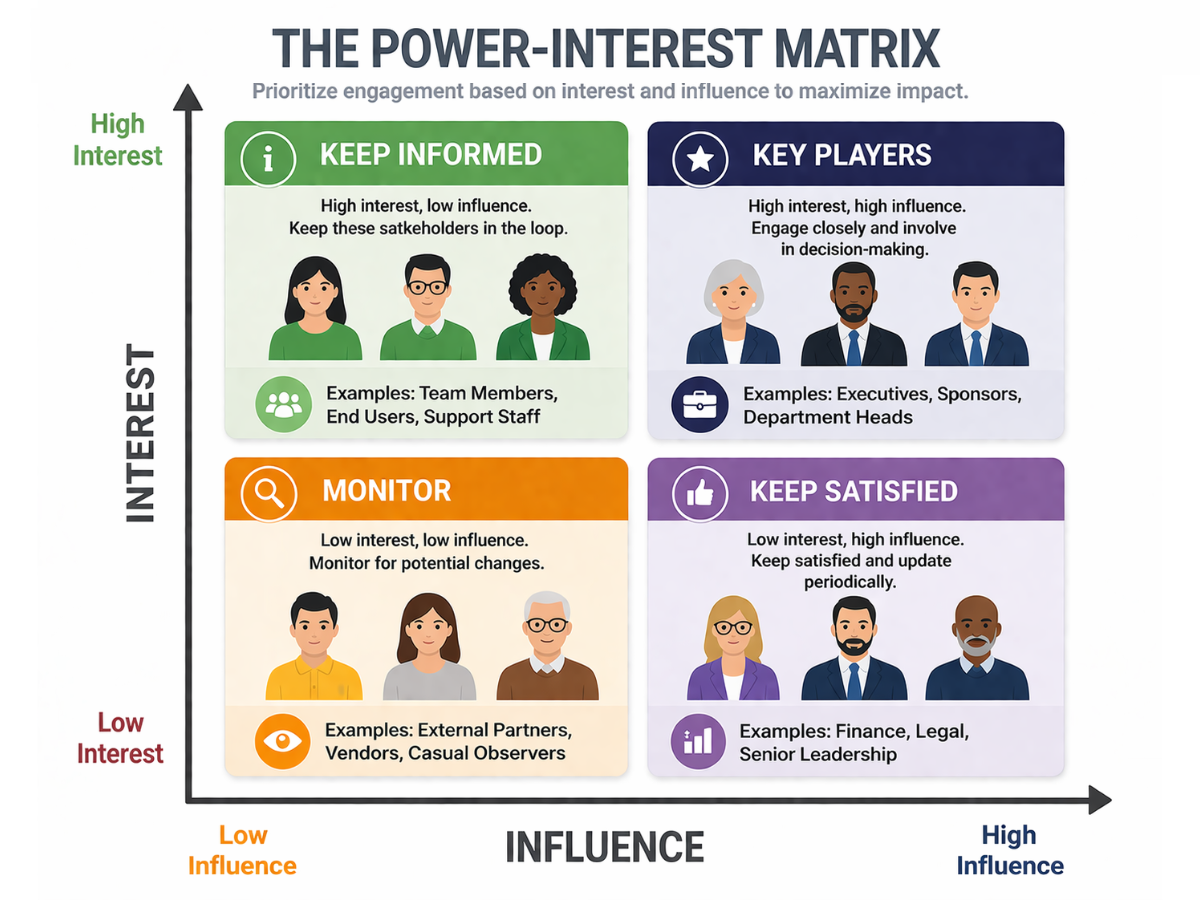
A framework for identifying key stakeholder groups and mapping their influence, interests, and concerns. This informs persona development and ensures communication and engagement efforts are targeted rather than generic.
Skills Gap Analysis
A tool for identifying training and capability requirements introduced by the change so that people develop the skills and knowledge needed for new ways of working before performance expectations shift.
Communications Plan
A plan that defines messaging, channels, owners, and timing for communicating change across the organization. A strong communications plan ensures the right audiences receive the right information at the right time, reducing ambiguity and reinforcing trust.
Active Participation and Engagement Planning
Structured approaches for involving people in the change beyond awareness. These include leadership forums, working groups, co-design sessions, and feedback mechanisms that give employees a meaningful role in shaping outcomes.
Training Resources
Materials and programs designed to build capability and confidence, from e-learning modules and process guides to facilitated workshops and peer coaching models.
Risk Assessment
A framework for identifying and managing people, process, and behavioral risks that could undermine change, including mitigation actions and escalation paths.
Artifacts
Branded visual assets, engagement decks, animations, video content, and templates that bring change to life with clarity and emotional impact. Strong artifacts create a recognizable identity and help leaders communicate with confidence and consistency.
Measurement and Sustaining Change
Data-driven methods for tracking adoption, gathering feedback, and measuring outcomes over time. Measurement is frequently underdeveloped in change programs; an effective toolkit embeds it from the start and sustains it well beyond go-live.
The Role of Change Management Toolkits in Driving Long-Term Success
Change management toolkits are often treated as delivery aids for individual projects. Their value extends much further. When they are designed with long-term organizational strength in mind, they support the development of lasting, enterprise-wide change capability.
Each program that applies the toolkit contributes to a growing base of institutional knowledge. Reusable assets reduce the time and cost required to launch future initiatives. Leaders who learn how to use the toolkit carry that capability into subsequent roles and assignments. Consistent measurement creates a reliable picture of where change is landing, where adoption is uneven, and where additional attention is required, enabling more informed strategic decision-making.
This distinction separates completing a project from building an organization that can adapt repeatedly. A well-constructed toolkit enables that shift.
Embedding Change Rather Than Delivering Projects
One of the most common failure patterns in change management is declaring victory at go-live. The system is activated, communications are distributed, and training sessions are completed. Without structured post-implementation support and measurement, adoption slows, workarounds emerge, and established behaviors resurface.
A well-developed change management toolkit for managers includes elements that remain active after launch, including feedback loops, measurement rhythms, reinforcement communications, and leader enablement tools that help sustain momentum throughout the embedding phase.
Building Organizational Capability for Future Change
Every change initiative presents an opportunity to strengthen the organization’s change management capability. Toolkits accelerate this process by giving leaders a structured, repeatable approach they can internalize and refine over time. As capability matures, reliance on external support decreases, and the organization becomes more resilient and better prepared for ongoing change.
Reinforcing a People-Centered Approach
The most effective change management toolkits are designed around people rather than processes. They recognize that change is fundamentally a human experience, requiring attention to emotion, identity, capability, and trust, alongside schedules and system deployments. This people-centered orientation, reinforced consistently across toolkit components, is what differentiates change that endures from change that gradually fades.
Best Practices for Building and Using a Change Management Toolkit
Avoid Generic, Document-Only Solutions
Off-the-shelf PDF toolkits downloaded from external sources rarely deliver meaningful results. They lack relevance to organizational context, fail to reflect culture, and seldom translate into practical action. A change management toolkit should be built or adapted to reflect the specific nature of the change, the operating environment, and the people affected.
Select Tools That Support Behavioral Change
The objective of a change management toolkit is adoption rather than compliance. Tool selection should address the behavioral and emotional aspects of change, in addition to operational considerations. Engagement activities, narrative-driven communications, and leader enablement materials carry equal weight alongside project plans and risk logs.
Add Value to Projects and Organizational Culture
Every element in the toolkit should serve a clear function, whether advancing the change, supporting people through transition, or strengthening future capability. Tools that do not contribute to one of these outcomes add complexity without delivering value.
Make It Accessible, Practical, and Engaging
Toolkits should be hosted digitally on an intranet, shared workspace, or purpose-built platform so they are easy to locate, easy to use, and genuinely interactive. Static documents that require extensive interpretation or customization are unlikely to be applied consistently. Accessibility directly influences adoption of the toolkit itself.
Train Leaders to Use It, Not Just Endorse It
Distributing the toolkit alone is insufficient. Leaders and managers need to understand how each component works, when it should be used, how it fits within the broader program lifecycle, and what an effective application looks like. Investment in onboarding and ongoing coaching delivers more consistent and confident use.
Continuously Improve Based on Feedback and Outcomes
A change management toolkit should evolve over time. Measurement and feedback mechanisms embedded within the toolkit highlight what is effective, what requires adjustment, and where gaps remain. Refining components between programs ensures the toolkit remains aligned with organizational needs. Static toolkits quickly lose relevance.
Change Management Toolkit Example: Rail Infrastructure Client
Project Overview
The Group HR directorate of a large rail infrastructure organization set out to introduce Systems Thinking across its operations. The initiative addressed the challenges associated with devolved structures and supported a broader modernization agenda that placed its 46,000-person workforce at the center. Afiniti was engaged to design a comprehensive change management toolkit that would equip local change leaders to champion Systems Thinking and support colleagues as new ways of working took hold.
The Toolkit Solution
The toolkit was designed to position local leaders as credible, confident advocates for Systems Thinking, providing them with the resources required to engage teams and link the change to strategic priorities.
Key components included:
- A pitch book connecting Systems Thinking to strategic objectives and efficiency goals, enabling leaders to present a clear and compelling narrative to senior stakeholders
- A visual identity that differentiated Systems Thinking from parallel initiatives and created an emotional connection to the change story
- An engagement deck that allowed leaders to facilitate effective sessions without deep subject matter expertise
- A concise animation that brought the Systems Thinking narrative to life for both enterprise-wide and local audiences
- User guides, solution descriptions, audience personas, and video success stories that gave leaders a broad set of assets for communicating with diverse stakeholder groups
Results
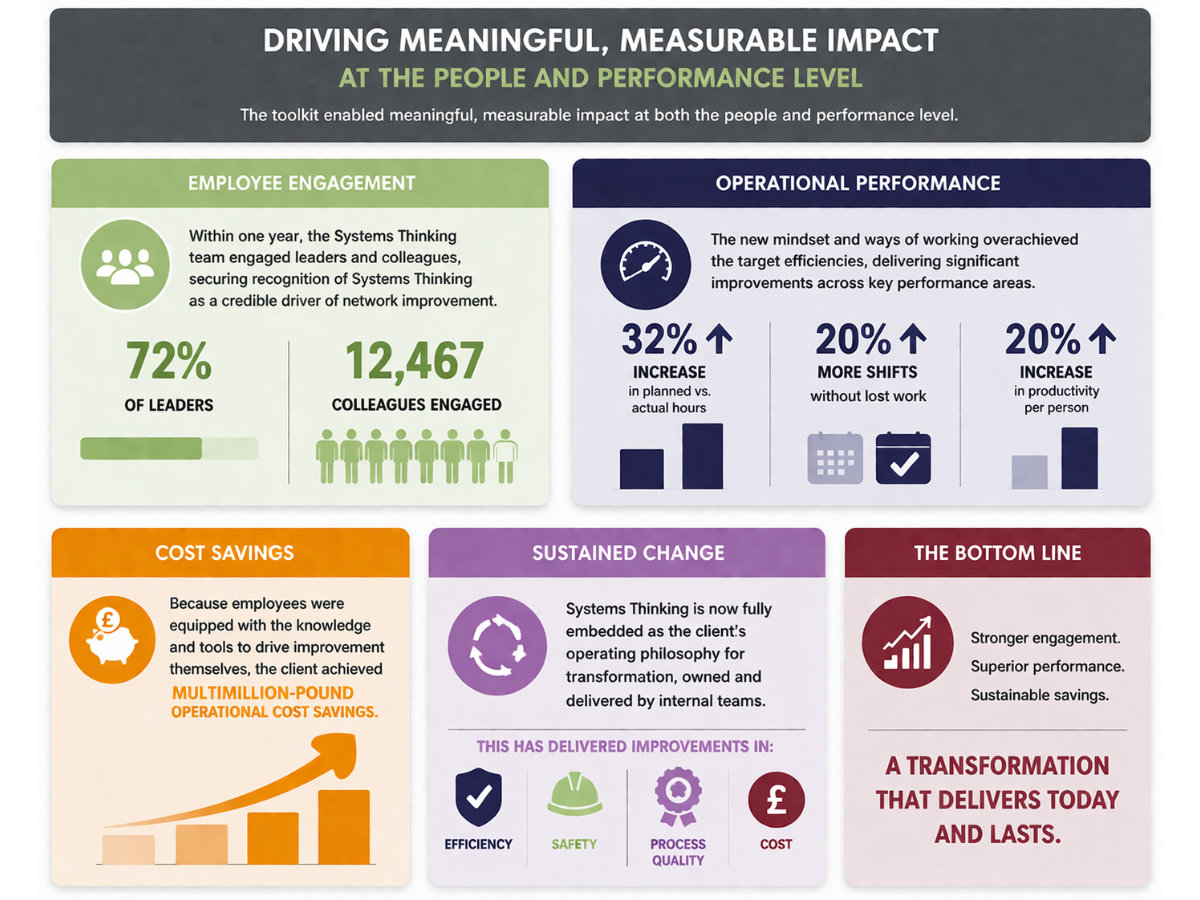
The toolkit delivered meaningful, measurable results across both people and performance dimensions.
- Employee engagement: Within one year, the Systems Thinking team engaged 72 percent of leaders and 12,467 employees, establishing Systems Thinking as a credible driver of network improvement.
- Operational performance: New ways of working exceeded efficiency expectations, generating a 32 percent improvement between planned and actual hours, 20 percent more shifts completed without lost work, and a 20 percent increase in productivity per employee.
- Cost savings: By equipping employees with the tools and knowledge to drive improvement independently, the organization achieved multimillion-pound operational cost savings.
- Sustained change: Systems Thinking is now fully embedded as the organization’s transformation operating philosophy, owned and delivered by internal teams, with measurable improvements across efficiency, safety, process quality, and cost.
Where to Start with Your Change Management Toolkit
A well-designed change management toolkit can accelerate delivery while reducing risk within your next program. To be effective, it must be comprehensive, context-specific, and built around the people experiencing the change.
An objective assessment of current readiness provides a strong starting point. Our free change readiness assessment takes five minutes and delivers an immediate, evidence-based view of how prepared your organization is for change.
From there, our team can collaborate with you to design, build, and deploy a change management toolkit aligned to your organization, your initiatives, and your leaders.
Ready to assess your change readiness?
Our change readiness assessment is a free online tool that will diagnose the strengths and gaps in your team’s readiness for change in just 5 minutes!
Change Management Toolkit FAQs
A change management toolkit is a structured collection of resources, templates, and strategies that give leaders and managers what they need to plan, communicate, and embed organizational change. It provides a consistent yet adaptable framework that can be applied across all phases of a change initiative, from early planning through post implementation adoption
A change management toolkit lowers the risk of poorly adopted or failed change by providing leaders with a structured, evidence based approach. It improves consistency in delivery, reduces rework, accelerates adoption, and strengthens organizational capability for future initiatives. The use of reusable assets also reduces the cost and effort required to deliver subsequent change programs.
Core components typically include a business case template, change readiness assessment, change impact assessment, stakeholder analysis, skills gap analysis, communications plan, engagement and participation tools, training resources, a risk assessment framework, branded artifacts, and measurement tools. The specific mix of components should be adjusted based on the nature, scale, and complexity of the change.
Traditional change management often focuses on applying a single methodology, such as ADKAR or Kotter’s 8 Step Model, consistently across initiatives. A change management toolkit is more flexible. It can span multiple methodologies, support agile or iterative delivery models, and be tailored to the cultural and operational context of the organization. The emphasis is practical application and leader ownership rather than reliance on external consultants.
